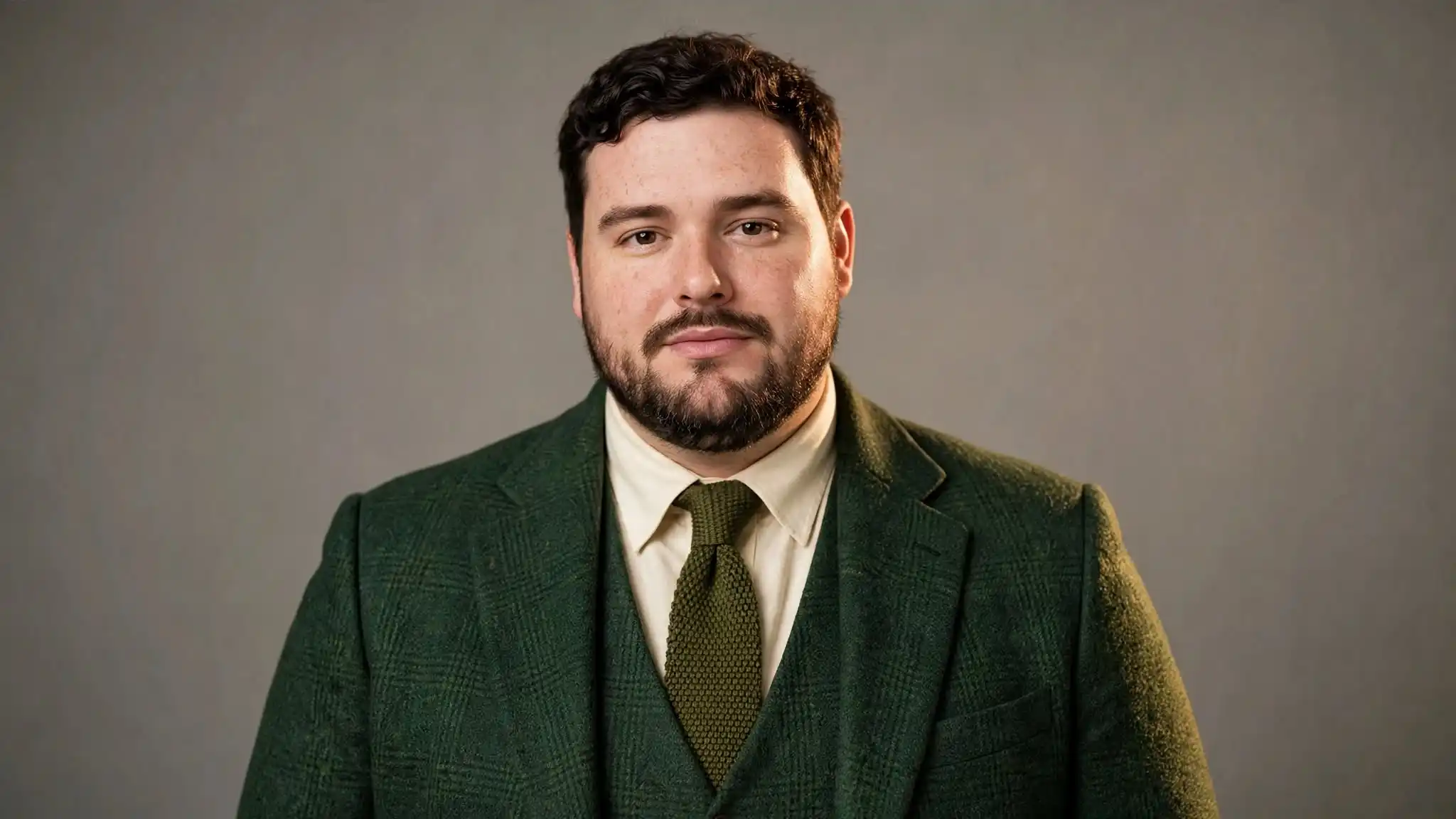
The average American man has a waist over 40 inches. Almost no suit on a shop rail is cut for him.
If you wear a 44 chest or bigger, you already know this. Good business attire for big guys is hard to find, and most style advice makes it worse.
You have tried. You bought the bigger size and it hung off your shoulders. You bought the one that fit your chest and could not fasten the button.
Then every guide told you the same two things. Wear vertical stripes. Wear dark colors. That is not advice. That is a shrug.
Here is what nobody says out loud. The worst part of a jacket that pulls is not how it looks. It is that you spend the whole client meeting thinking about it instead of the work.
Find Out What the Client Expects Before You Open Your Closet

Most men guess the dress code. Then they spend the first ten minutes of the meeting wondering if they guessed right.
Skip that. Spend five minutes checking instead.
The working rule is simple. Dress one step above your client. One step reads as respect. Two steps reads as a costume.
Three ways to check before you go:
- Look at their photos. Check the client’s website team page and their LinkedIn profiles. What people wear in their own headshots is usually close to what they wear at work.
- Ask the person who booked it. Keep it light: “Quick question so I turn up right. Is your office more jacket or more polo?” Almost everyone answers happily.
- Fall back on the industry. Law, banking, insurance and government stay formal. Tech, media and startups do not. Trades, services and sales sit in the middle.
Many offices no longer have a written dress code at all. The client meeting is the one place the jacket survived.
Keep a blazer at your desk or in your car. An unplanned client visit should never catch you in a polo.
This step matters more when you are bigger, not less. You cannot improvise at the last minute from a closet holding three things that actually fit.
Why Store Bought Suits Fail Bigger Guys
This is the part nobody explains, and it changes how you shop forever.
A suit is cut from one paper pattern. To make larger sizes, the factory scales that same pattern up. Everything grows at once.
Go up in chest size and the sleeves get longer. The shoulders get wider. The jacket gets longer. The armholes drop lower.
Your body did not grow that way. A bigger middle does not come with longer arms or wider shoulders.
So the jacket that finally buttons over your stomach arrives with sleeves past your knuckles and shoulders hanging off the edge. Nothing about that is your fault.
The drop problem
Suits are usually sold as a set, with a fixed gap between the jacket size and the pants size. A 46 jacket often comes with 41 pants.
If your waist sits closer to your chest than that gap, those pants will never work. No alteration saves them.
That is why suit separates matter so much. Buying the jacket and the pants as two pieces lets you pick each one by your own number.
What a tailor can fix and what they cannot
| Can be fixed | Cannot be fixed |
|---|---|
| Sleeve length | Shoulder width |
| Jacket waist taken in | Jacket length |
| Pant waist and hem | Pocket and buttonhole position |
| Shirt body slimmed | Armhole height |
Read that table twice. The left column tells you what to buy. The right column tells you what to walk away from.
The 6 Fit Points That Decide How You Look
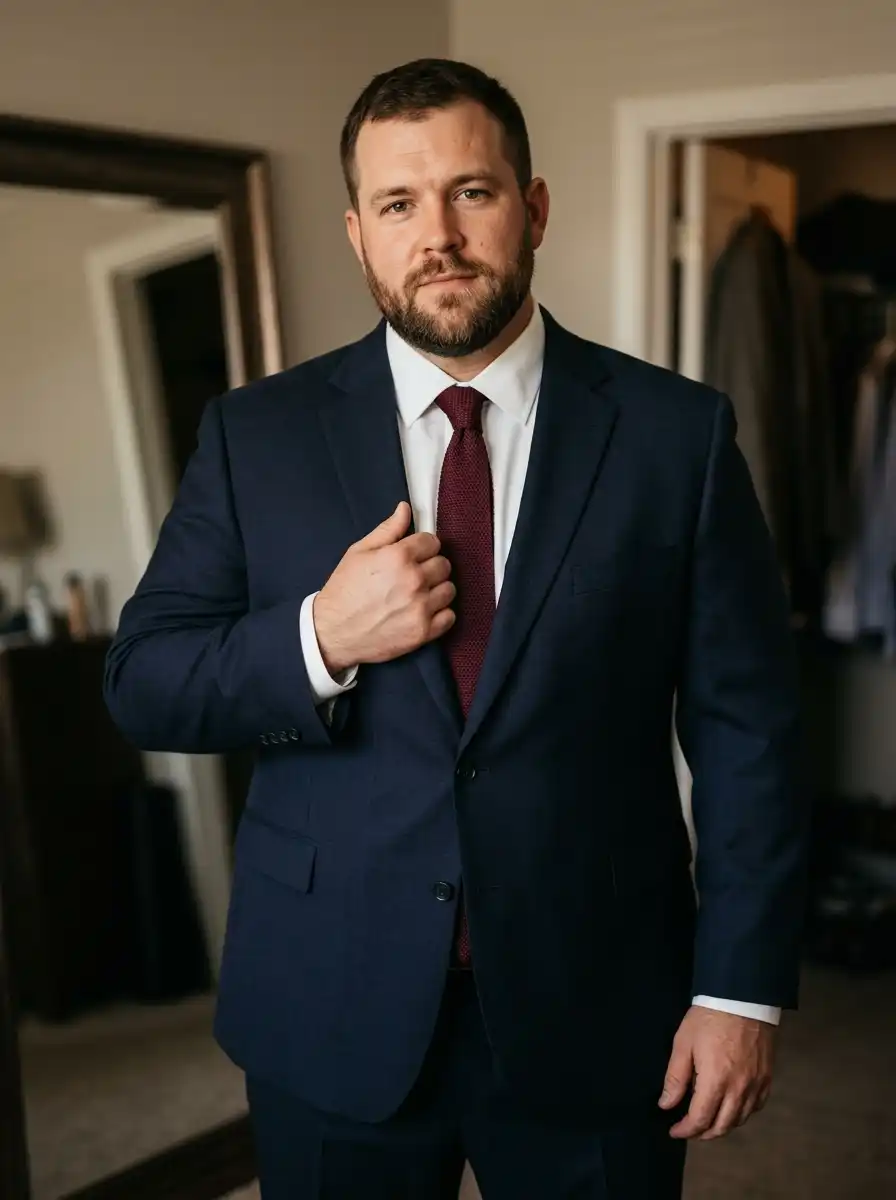
People judge your clothes in about five seconds, before you say a word. They are not reading the label. They are reading the fit.
Here are the six places that matter, working down the body. Each one comes with a test you can run right now.
1. Shoulders. The seam should sit just past your shoulder bone. More than a thumb’s width past it and the jacket is too big.
Test: Stand sideways to a mirror. If the shoulder pad juts out into empty air, put it back.
This is the one thing a tailor cannot really change. So it decides which jacket you buy, before anything else.
2. Button stance. The jacket should close at your natural waist, around your navel or just above. Too low and your legs look short. Too high and your stomach pushes out below it.
Test: Button the jacket. The button should land at or above your belly button, not under it.
3. Shirt collar. It should sit snug against your neck with one finger of room. No more.
Store shirts scale the neck along with the body. So a big guy with an average neck ends up in a collar that gapes open.
Test: Button the top button. Slide one finger inside. Two fingers means you need a smaller neck size and a bigger body.
4. Pant rise. Pants belong on your natural waist, not slung under your stomach.
Worn low they slide down all day, bunch over your shoes, and drag the whole look apart.
Test: Sit down for a minute, then stand. If you have to hike them up, the rise is too short.
5. Armholes. A higher, smaller armhole feels better, which sounds backwards but is true.
Test: Raise both arms. If the whole jacket lifts with them, the armhole is too low and too wide.
6. Jacket length. It should cover your seat. Short modern cuts frame the exact area you would rather leave alone.
Test: Let your arms hang. The jacket hem should land around the curl of your fingers.
If you fix only one of these, fix the shoulders. Everything else can be bought around or altered later.
3 Client Meeting Outfits You Can Build This Week

Pick the one that matches the meeting in your calendar. The three overlap on purpose, so you are not buying three wardrobes.
Outfit 1: The full suit
Best for law, banking, insurance, and any first meeting with a traditional client.
- Single breasted, two button, notch lapel, in navy or charcoal, no pattern
- Lapels around 3.5 inches wide. Very thin or very wide both look odd on a bigger frame
- Side vents or no vents. One vent up the back gapes open the moment you sit
- Pleated pants on your natural waist, held up by braces instead of a belt
- White or light blue shirt with a standard point collar
- A tie around 3.5 inches wide with a medium knot. Buy extra long ties if yours stop short above your belt
- Optional vest. It smooths your middle and adds formality in one move
Why braces beat a belt: a belt cuts you in half at your widest point and still lets the pants slide down. Braces hold the waistband exactly where you set it, all day, with no hiking up after you stand.
Outfit 2: Blazer and pants
Best for most client meetings. Safe almost anywhere.
- Navy blazer with soft or light shoulder padding
- Grey or stone pants in a different cloth from the jacket
- Shirt open at the collar, or a shirt with a knit tie
- Leather loafers or plain lace up shoes
Buying the jacket and pants separately kills the drop problem completely. For most bigger guys this one change does more than anything else on this page.
Outfit 3: Sharp business casual
Best for tech, creative, trades, and site visits. This is also the most comfortable big and tall business casual setup for hot days.
- A long sleeve knit polo, or an overshirt in a structured cloth
- Dark chinos with a proper rise
- Clean leather shoes. A plain leather sneaker works in tech if it is spotless
- One good watch and nothing else
A tip from men who dress like this every day: knit polos are the real answer to sweating in a formal industry. They look finished, they breathe, and they do not show strain lines across the front.
The one upgrade that costs you nothing extra
Shoes fit the same no matter your size. They are the only part of your outfit that store sizing never punishes you for.
So a good pair of leather shoes is the best value purchase you can make. Buy once, polish often, and they lift everything above them.
Fabric and Sweat: How to Stay Sharp for Two Hours

Half the internet tells bigger men to wear light fabric. Classic menswear says heavy cloth hangs better. Both are half right.
The answer is weave, not weight.
A mid weight wool with an open weave gives you both at once. Look for fresco, hopsack, or tropical wool. They hold their shape and still let air pass through.
Four things that help more than the cloth itself:
- Skip cheap polyester suiting. It traps heat and shows every ripple in the fabric
- Buy wool with a little stretch. This is the biggest real improvement in large sizes in years, and most big and tall lines now carry it
- Wear a fitted moisture wicking undershirt. Loose cotton soaks through and shows. A fitted technical one does not
- Put antiperspirant on at night, not in the morning. It needs hours of still, dry skin to work. Morning application washes off before it does its job
Keep a spare shirt in the car in summer. Changing in a parking lot is not defeat. It is planning.
Color, Pattern, and the Advice You Should Ignore
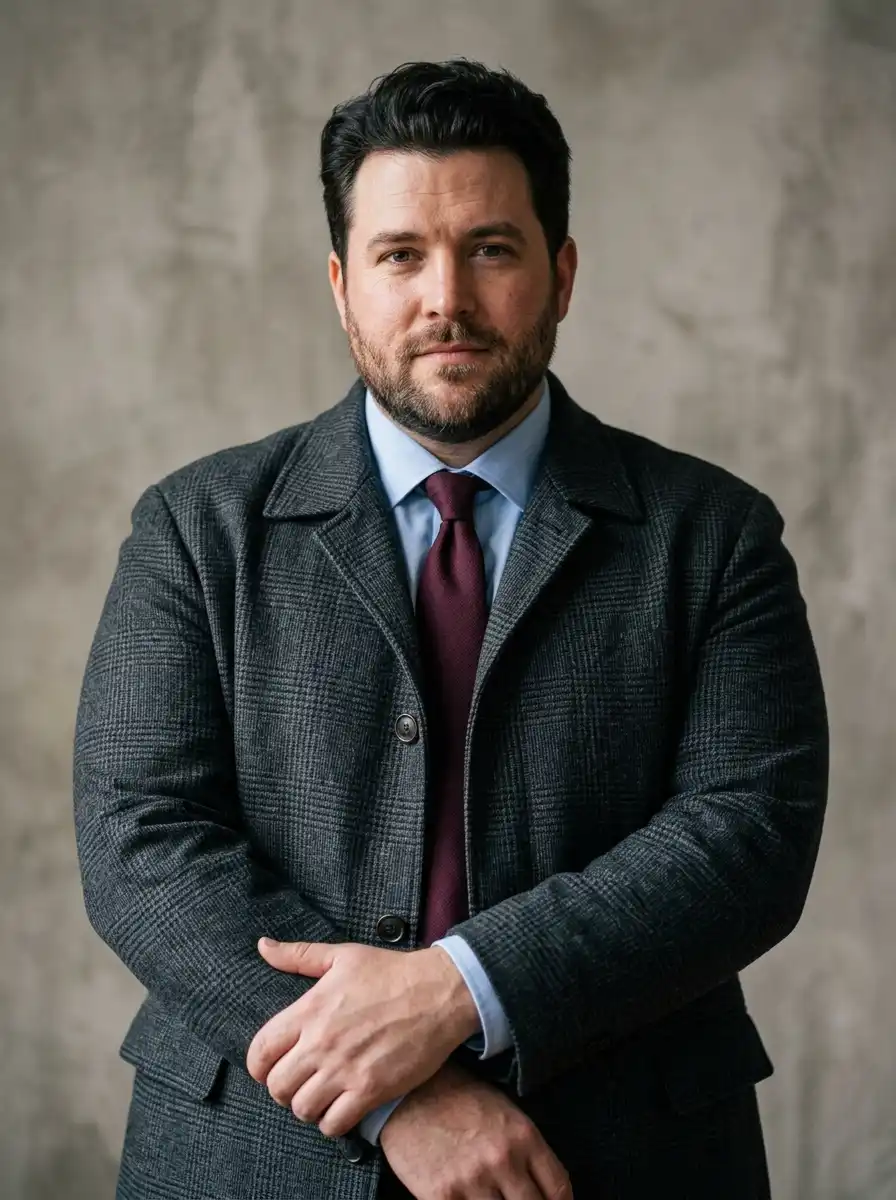
You have been told to wear vertical stripes since you were fifteen. It is the most repeated tip in this category and close to useless on its own.
Here is what actually changes how you read in a room.
Keep your colors close together. Dark solids in navy and charcoal work because one unbroken color reads as a single shape. Break it with a pale belt or light pants and you create a hard line across your middle.
Match pattern size to your frame. A pattern that suits a slim man gets lost or exaggerated on a bigger one.
| Pattern | Verdict |
|---|---|
| Fine pinstripe | Works, if the contrast stays soft |
| Wide chalk stripe | Skip it. It adds visual width |
| Large glen check, low contrast | Works well on a big frame |
| Bold windowpane | Skip it |
| Anything horizontal across the middle | Skip it |
Scale your details too. Slightly larger buttons and pocket flaps stay in proportion on a bigger jacket. Tiny ones look lost and make the jacket read as borrowed.
On collars, the usual advice is backwards. Plenty of guides push wide spread collars on bigger men. Classic menswear says the opposite, because a very wide collar widens your face.
A standard point collar, average width or a touch above, is the safer call. Try both in a mirror and trust what you see.
Where to Buy and What to Spend
Three routes. All of them beat an expensive suit that fits badly.
| Route | What you get | Best for |
|---|---|---|
| Store bought plus alterations | Fastest option. Big and tall lines carry chest sizes into the 60s and waists into the 60s | Your first good suit |
| Suit separates | Jacket and pants bought by your own two numbers | Anyone whose waist sits close to their chest |
| Made to measure | The pattern is cut to your measurements, so the scaling problem disappears | Your second suit, or if store sizes never work |
Three alterations fix most store bought suits. Shorten the sleeves. Take in the jacket waist. Hem and adjust the pants.
Budget for those before you buy, not after. A cheaper suit plus good alterations beats a pricier suit worn straight off the rail, every time.
Where to look
- Big and tall specialty stores. The widest size range and staff who fit larger men all day. Worth the trip even if you buy online later
- Department store big and tall lines. Most major menswear chains now carry extended suiting, often with a roomier cut option
- Shirt specialists. These sell neck and sleeve as separate numbers, which solves the big body and average neck problem
- Tall specialists. If you are tall rather than broad, these fit far better than big and tall ranges
- A local tailor. The highest return money in this whole guide. Call three and ask what they charge for sleeves, a jacket waist and a hem
The one rule for shopping online
Buy by measurement. Never by letter size.
An XL means nothing. A 48 chest means something.
Measure these five once and save them in your phone:
- Chest, around the fullest part, tape level under your arms
- Natural waist, at your navel, not where your pants currently sit
- Neck, with one finger under the tape
- Sleeve, from the bone at the base of your neck, over the shoulder, to your wrist
- Inseam, from crotch to the top of your shoe
Then check them against every brand’s own chart before you order. Sizing varies wildly between brands, and the chart is the only thing that does not lie.
The 10 Minute Check Before You Walk In

Run this list in the car. It catches almost everything.
- Button the jacket standing up. If the fabric pulls into an X shape around the button, it is too tight through the body
- Practice the habit. Button when you stand, unbutton when you sit. Every time
- Raise both arms. If the jacket lifts with them, your armholes are too low
- Check the gap between your shirt buttons at the widest point. A straining shirt front is the most noticeable fit problem there is
- Pull your pants to your natural waist. No bunching over the shoes
- Line up your shirt placket, belt buckle and fly. They should sit in one straight vertical line
- Wipe your shoes. Free, fast, and almost nobody bothers
- Empty your pockets. Bulk ruins a jacket’s line faster than anything else on this list
If the meeting is on video
Three extra things, and they take one minute.
Put the camera at eye level, so you are not shot from below. Frame yourself from mid chest up. Then look at your collar and shoulder line on screen, because that is the entire outfit as far as your client is concerned.
The Bottom Line
The problem was never your body. It was a pattern cut for somebody else and scaled up.
Six fit points decide almost everything, and most of them cost less to fix than you expect. Solid business attire for big guys comes down to three habits: buy for your shoulders, pay a tailor for the rest, and find out what the room expects before you leave the house.
Own one outfit that fits properly instead of four that nearly do. One correct look, worn again and again, solves client meetings for good.
Start today. Measure your chest, waist, neck, sleeve and inseam, then save those five numbers in your phone. Every good decision from here depends on them.
FAQs
Should a bigger guy wear slim fit or classic fit?
Neither label matters as much as the shoulder seam. Buy the smallest size that fits your shoulders and lets you move, then have a tailor take in the waist. A well altered classic fit beats a straining slim fit every time.
Do vertical stripes really make you look slimmer?
Barely. One unbroken color from shoulder to shoe does far more than any stripe. A fine pinstripe helps a little. A wide chalk stripe actually makes you look wider, so skip it.
Is a belt or braces better if you have a bigger stomach?
Braces, in almost every case. A belt sits at your widest point, cuts your body in half visually, and still lets the pants slide down. Braces hold the waistband where you set it and stay comfortable when you sit.
What should I wear if the client has no dress code?
A navy blazer with grey pants and an open collar shirt. It reads one step above almost any room, and you can take the jacket off in seconds if you judged it wrong.
How much should I spend on my first good suit?
Spend less on the suit and leave room for alterations. A mid range suit plus three alterations will look better than a premium one worn straight off the rail. Ask your tailor for a quote before you buy.