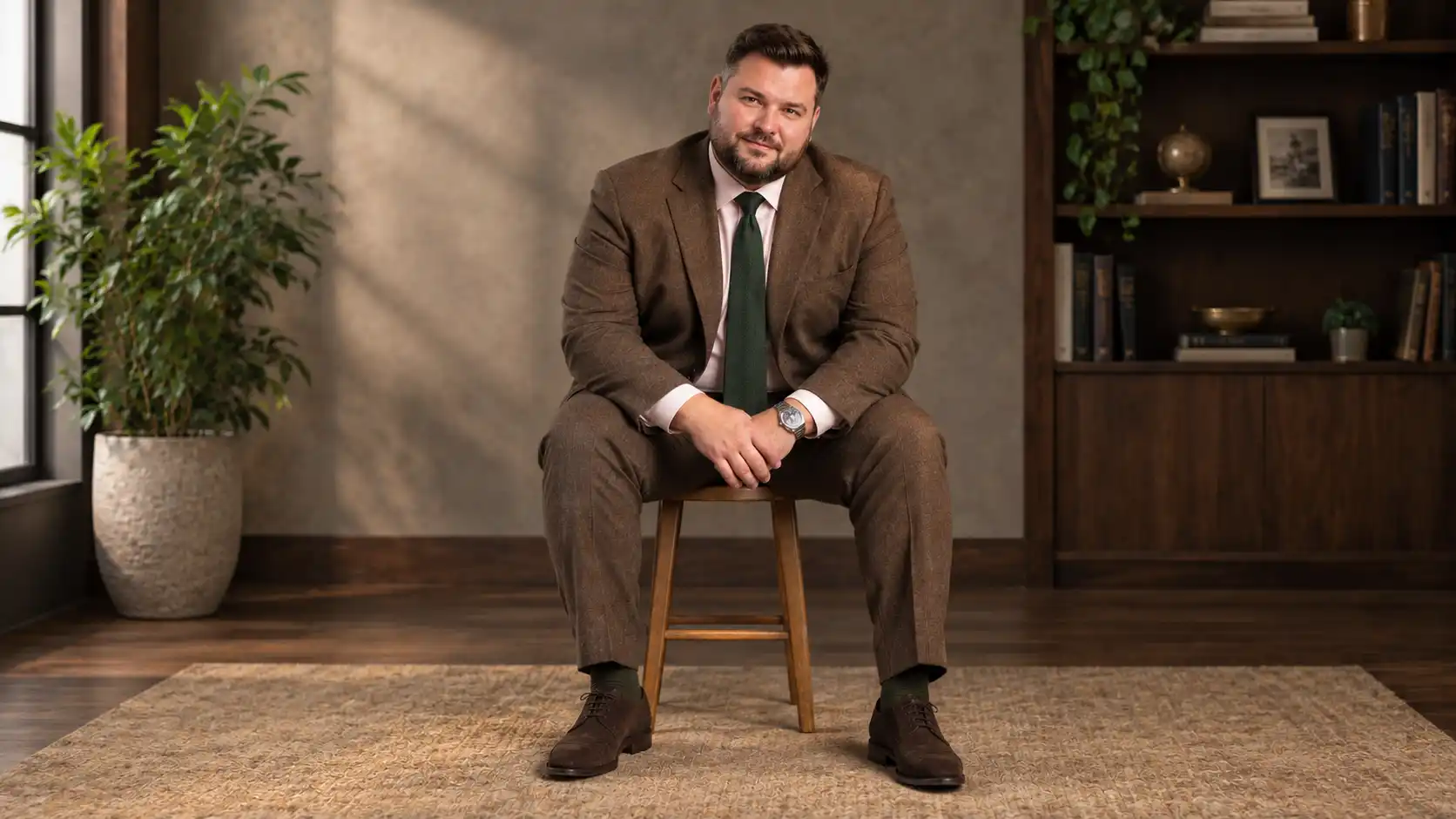
Ten minutes into my first real meeting at an insurance office, I leaned across the table for a handout. The shirt button over my belly pulled open.
I spent the next hour holding a notebook over the gap. That shirt was the “right” size on the tag, and the wrong size for sitting at a desk.
Learning how to dress for a corporate job as a plus size man has very little to do with trends. It comes down to buying pieces that pass a few fitting-room tests.
They should stay closed when you sit, stay tucked when you reach, and still feel fine at 4 p.m.
By the end of this guide, you’ll have a five-day work rotation built from two blazers, four dress shirts and two pairs of trousers.
You’ll know which numbers to bring to the store and how to test each piece before you pay. You’ll also know which two fixes to hand to a tailor.
This method works because it starts with what your office expects, not with what a store wants to sell you.
Plan on about four hours of shopping, one short tailor visit, and roughly a week of waiting. None of it is hard. It only has to happen in the right order.
Watch how your manager’s manager dresses for one full week

Your offer letter might say “business professional,” but that phrase means different things in different buildings. The people two levels above you show what it means in yours.
Dressing to their level, not the intern’s, tells everyone you take the job seriously from the first day.
Give it 5 workdays, and let Monday through Thursday count the most. Many offices loosen up on Friday, so a Friday polo tells you nothing about Tuesday. Notice three things:
- Jacket on, or shirt sleeves only?
- Tie, or open collar?
- Leather dress shoes, or loafers and clean sneakers?
If most of them wear a jacket and tie, your office is business formal and every step here applies to you. If jackets show up but ties don’t, you’re in business casual. Keep the blazer and skip the tie in Step 9.
Haven’t started yet? Look at team photos on the company’s LinkedIn page. Or ask your recruiter what people on your team wear on a normal Tuesday.
Record your true neck size with the top button closed
Half an inch is the difference between a collar you forget about and one that squeezes you by lunch.
Big-and-tall dress shirts are sold by neck and sleeve size, so this number shapes almost everything you try on in the store.
Wrap a soft tailor’s tape around the base of your neck, right where a shirt collar sits. Slide two fingers under the tape and read the number.
Round up to the nearest half inch, so 19¼ becomes 19½. Measure on bare skin or over a T-shirt, never over a collar, or you’ll add a size you don’t need.
While the tape is out, get your sleeve length too. Start at the center back of your neck, run over your shoulder, and stop at your wrist bone with your arm slightly bent.
Then sit down and measure around your waist at your navel, which is the number Step 4 needs.
Save all three numbers in your phone notes. No tape at home? Use a charger cable or string, pinch the spot with your thumb, then lay it against a ruler.
Button the fitting-room shirt to the collar and sit down
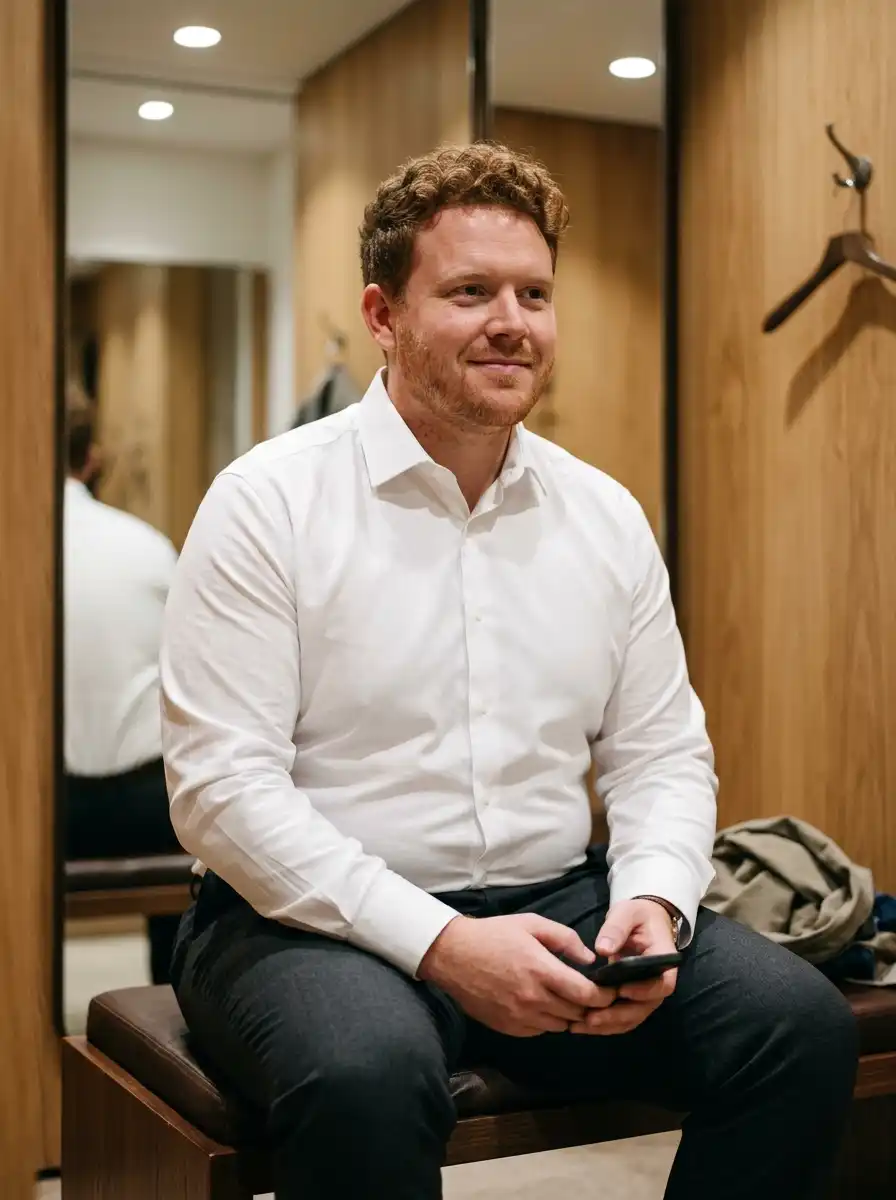
Standing in front of a mirror, almost every shirt looks fine. Your workday happens in a chair, leaning toward a keyboard, so that’s where the real test belongs.
Take two shirts in your neck and sleeve size into the fitting room: one classic fit and one modern fit. Wear your thin undershirt so you feel how the shirt will fit on a workday.
Close every button, including the collar. Then sit on the bench and lean forward like you’re typing. Check four spots:
- Collar: two fingers slide in, but not a whole hand.
- Belly: no gaps and no X-shaped pull lines between buttons.
- Shoulder seam: sits on the edge of your shoulder, not down your arm.
- Cuffs: end at your wrist bone when your arms hang.
If the collar fits but the buttons pull, keep the same neck size and look for a “big” or “full” cut instead of a “tall” cut. Big cuts add room through the chest and middle. Tall cuts only add length.
Shopping online? Do the same sit-down test at home and keep the tags on until the shirt passes.
Buy plus size trousers that sit at your navel, not under your belly
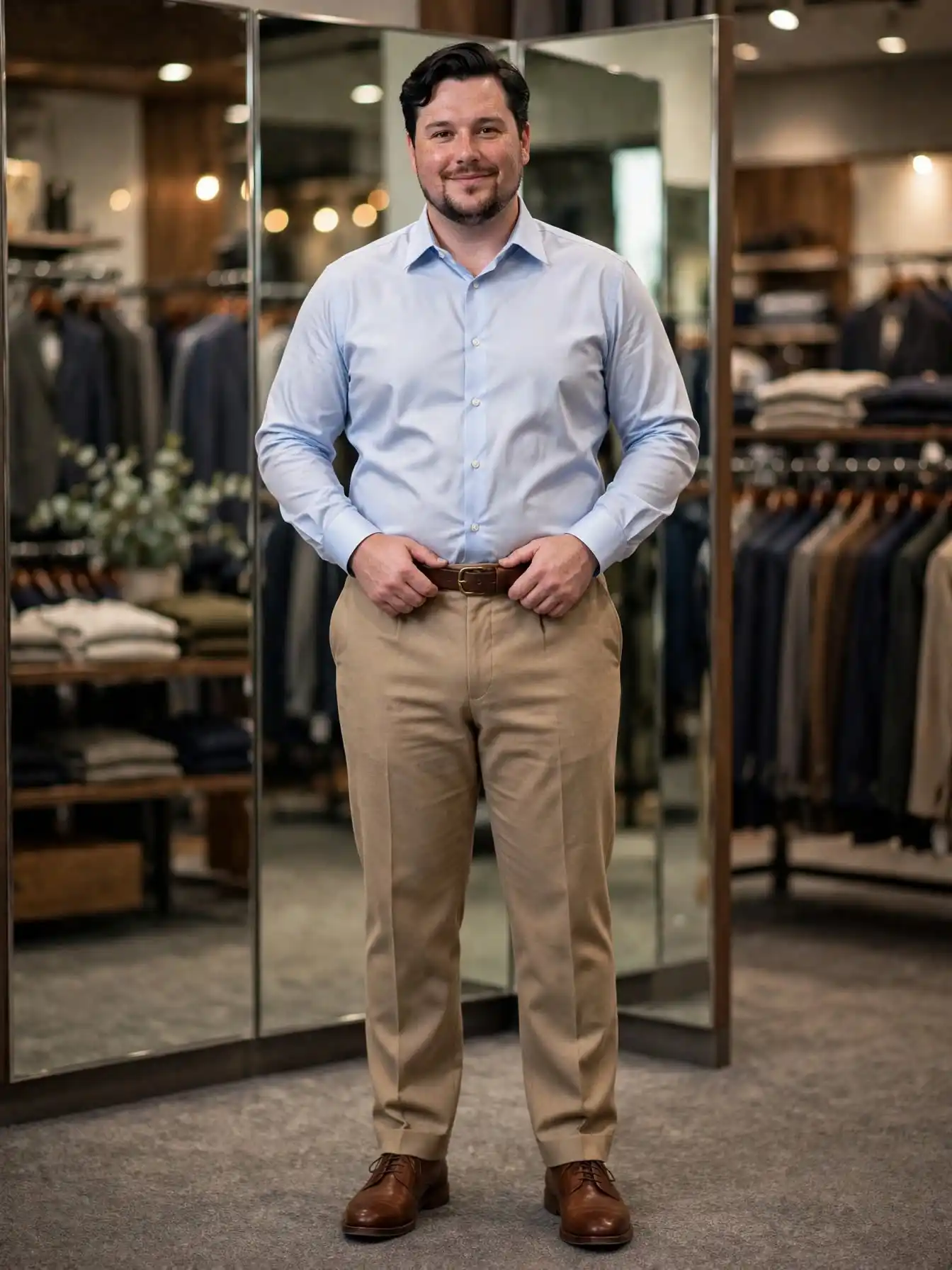
Low-rise trousers are the reason so many big guys spend the day hiking up their pants. A waistband that sits under the belly has nothing to hold onto, so it slides down. Your shirt follows it out.
Look for a front rise of about 11 to 13 inches. That’s the distance from the crotch seam to the top of the waistband, and many big-and-tall brands list it on the product page.
At that height, the waistband rests at your navel and stays there when you sit.
Flat-front trousers give the cleanest line under a blazer. If your thighs are thick, a single pleat adds room without much bulk. A wool blend with 2–3% stretch moves with you through a long day.
Try on the seated-waist size from Step 2 first. Hidden side adjusters or a stretch waistband give you about 2 inches of extra room. Leave the hems long, because the tailor handles those in Step 7.
Test the blazer’s shoulder seam
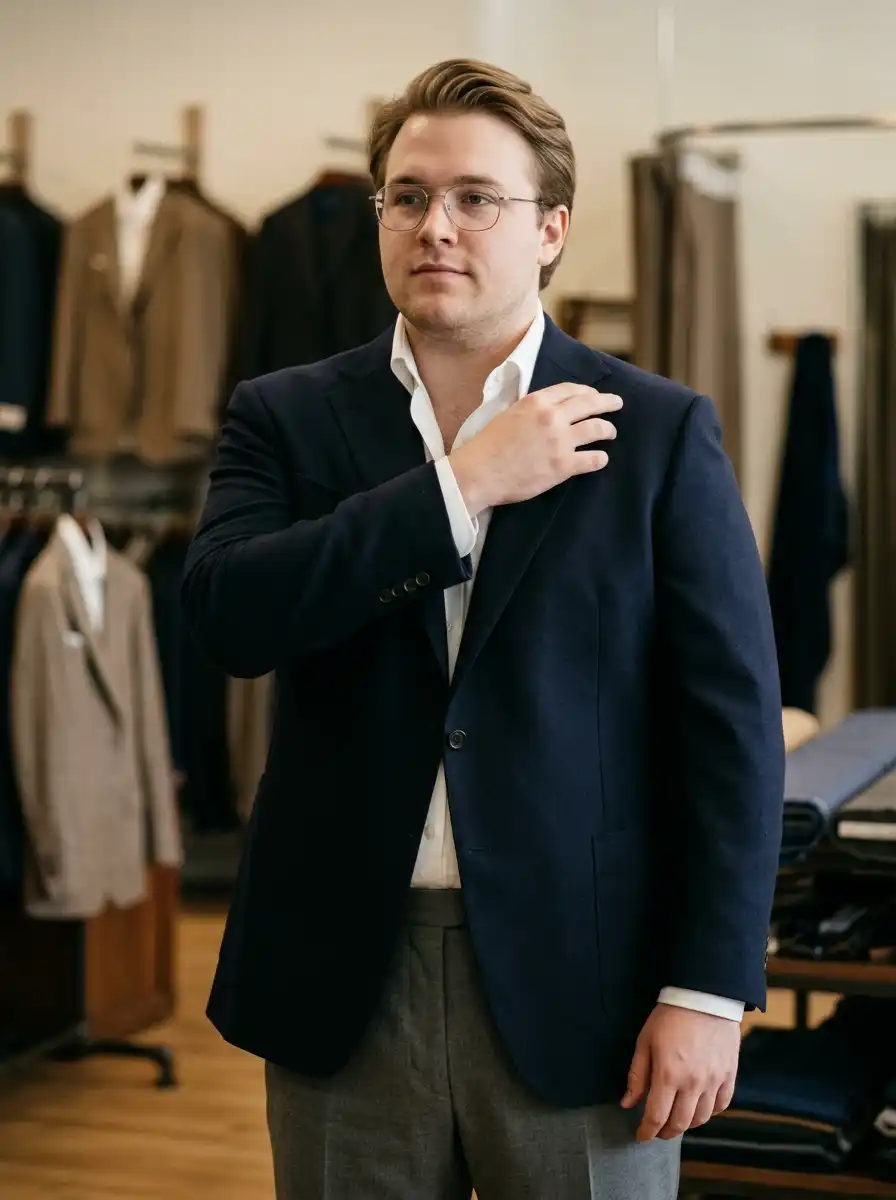
If a blazer fits your shoulders, a tailor can fix almost everything else on it. That’s why this test comes before color, price or brand.
Wear one of your new dress shirts and put the jacket on. Find the seam where the sleeve joins the body. It should end right at the edge of your shoulder bone.
Stand sideways next to a wall. Your arm should touch the wall before the jacket’s shoulder does.
⚠ No Tailor Can Move This Seam
Shoulders are the one part of a blazer a tailor can’t fix for a fair price. If the seam hangs more than ½ inch past your shoulder bone, put the jacket back. Don’t size up to close the button over your belly. Ask for a “portly” or “big” cut instead, which adds room through the middle without widening the shoulders.
With the jacket on, close the top button of a two-button blazer. It should meet without X-shaped pulls across your stomach.
Raise both arms to steering-wheel height, and check that the collar stays against your neck.
Single-breasted, two-button jackets in navy or charcoal are the safest buys. Double-breasted styles add width across the middle.
Match belt and shoes — and size the belt 2 inches up

One color of leather from your waist to your feet makes an outfit look planned. Dark brown works with navy, gray and tan. Black works best with charcoal and in the most formal offices.
Add 2 inches to your trouser waist to get your belt size, so a 44-inch waist needs a 46 belt.
Buckled, it should close on the middle hole, which leaves room on both sides. A 1.5-inch width suits a bigger frame, while skinny belts look lost. Pick a plain metal buckle with no logo.
For shoes, derbies with open lacing fit wide feet and high insteps better than closed-lace oxfords. Before you pay, check these three things:
- Width: ask for E, EE or EEE if the standard width pinches.
- Time of day: shop after 3 p.m., when feet are at their largest.
- Soles: rubber or rubber-tipped soles cushion long days on hard office floors.
Hand the tailor two jobs: trouser hems and blazer sleeves
Wear the exact shoes and one of your new dress shirts to the fitting. A hem pinned over sneakers will land wrong the first time you put on your work shoes.
For the trousers, ask for a “slight break.” The front of the hem rests on top of your shoe with one small, soft fold. The back stops about 1 inch above where the heel meets the sole.
Extra fabric bunching at the ankle makes your legs look shorter and your middle look wider.
Stand straight with your eyes forward while the tailor pins. Looking down pulls the fabric and throws off the length.
For the blazer, ask for sleeves that show ¼ to ½ inch of shirt cuff with your arms at your sides. That thin strip of white or blue makes an off-the-rack jacket look made for you.
Both jobs together usually cost about the same as one good dress shirt. Expect to wait 3 to 7 days.
Hang five weekday outfits on Sunday night

Mornings go wrong when you get dressed half awake and in a hurry. Ten minutes on Sunday settles the whole week. Your two blazers, four shirts and two trousers mix like this:
- Monday: navy blazer, white shirt, gray trousers
- Tuesday: charcoal blazer, light blue shirt, tan trousers
- Wednesday: navy blazer, second light blue shirt, tan trousers
- Thursday: charcoal blazer, second white shirt, gray trousers
- Friday: navy blazer, Monday’s white shirt (washed midweek), tan trousers
Each blazer shows up with both pairs of trousers, so coworkers rarely notice a repeat.
Hang each day’s shirt under its blazer on one wide, shaped hanger. Thin wire hangers leave bumps in the shoulders. While you hang them, check each shirt for a loose button or a wrinkled collar so nothing surprises you at 7 a.m.
Knot a 63-inch tie so the tip meets your belt buckle
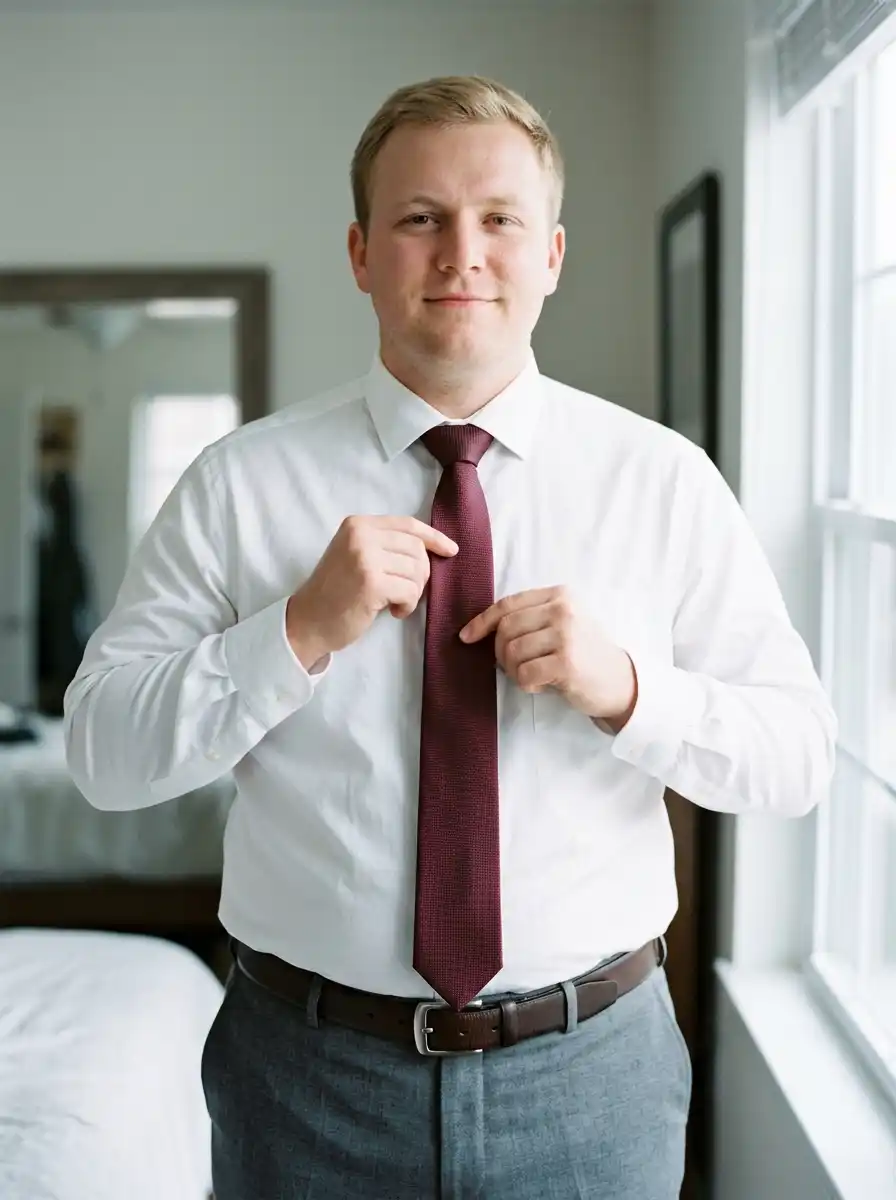
Standard ties run about 57 to 59 inches. Around a 19-inch neck and down a broad chest, that length runs out halfway down your stomach. An extra-long tie of 61 to 63 inches fixes that. Go longer if you’re also tall.
Width matters too. A tie 3.25 to 3.5 inches wide matches bigger lapels and a bigger frame. Skinny ties on a large chest look like a ribbon on a gift box.
Use a four-in-hand knot, which uses the least fabric and suits most shirt collars. Drape the tie with the wide end hanging about 12 inches lower than the narrow end. Tie it, then tighten until the knot fills the gap in your collar.
The tip should touch the top of your belt buckle. Above it looks short, and past it looks sloppy. If yours misses, untie it and move the starting point 2 inches in the right direction.
Business casual office? Skip the tie, leave the top button open, and slip plastic collar stays in so the collar stands up all day.
Wear It for Five Days, Then Fix One Thing
You now know how to dress for a corporate job as a plus size man: shirts that stay closed, trousers that stay up, and a blazer that fits where it counts.
Here’s your challenge for this week. Wear all five outfits from Monday to Friday, and notice the one piece you keep tugging, tucking or unbuttoning.
Fix or replace only that piece next. One fix is enough, and you don’t need a whole new closet.
Save this pin to your work-wear board so the fitting-room tests are on your phone the next time you shop.
Questions Plus Size New Hires Ask Most
Do I unbutton my blazer when I sit down?
Yes. Undo it as you sit and close the top button again when you stand. On a two-button jacket, the bottom button stays open every time.
Can a cardigan replace the blazer in a business casual office?
Yes, if it’s a fine-knit V-neck in navy or charcoal worn over a collared shirt. Skip chunky cable knits, which add bulk across your middle.
Are suspenders more comfortable than a belt with a big midsection?
For many big men, yes, because the trousers hang from your shoulders instead of squeezing your waist. Get button-on suspenders (a tailor can add the buttons), since clip-ons slip. Wear one or the other, never both.
Do striped dress shirts make me look slimmer?
Thin, close-set stripes are fine, but wide, bold stripes stretch out across the stomach and draw the eye there. Fit does far more than pattern, so start with solids.
How often should the blazers go to the dry cleaner?
About every 6–8 wears, or sooner if you spill something. Between cleanings, brush the jacket and let it air out overnight on a wide hanger.