You put on a new button-up, look in the mirror, and see a wall. Your shoulders, chest, and belly blend into one wide block from your neck to your waist. That boxy look is not your body’s fault.
It comes from shirts cut too big, necklines that run straight across, and jackets that pile on width where you already have plenty. Learning how to dress broad shoulders as a plus size man mostly comes down to fixing those three things.
By the end of this guide, you’ll know your real measurements, the fit to look for, and the small swaps that make your top half look longer and more balanced.
Nothing here is about hiding your shoulders. Broad shoulders are a strength. The goal is to frame them so the eye moves up and down instead of side to side.
This method works because it starts with fit. Most bigger guys size up to make room for their stomach. The shoulder seam then hangs halfway down the arm, and that one mistake makes everything else look wider.
Here is the honest time cost. Measuring and checking your closet take about 1 hour. Tailoring takes 1 to 2 weeks. Grab a tape measure and your favorite shirt, and let’s start.
- ✓ Soft tape measure (or string + ruler)
- ✓ Your best-fitting shirt
- ✓ Full-length mirror
- ✓ Phone camera
- ✓ Notes app or notebook
- ✓ A friend to hold the tape (optional)
- ✓ Dark V-neck tee
- ✓ Open-collar button-up shirt
- ✓ Unstructured blazer or overshirt
- ✓ Straight-leg dark jeans or chinos
- ✓ Safety pins (to mark tailoring)
- ✓ A local tailor
- Measure your shoulders and chest with a soft tape
- Find where the shoulder seam lands on your best shirt
- Size for your shoulders, not your stomach
- Pick V-necks and open collars to narrow the top
- Add vertical lines down the front
- Choose blazers with soft, unstructured shoulders
- Drop shoulder pads, epaulettes, and wide stripes
- Wear darker solids on top
- Balance your top half with straight-leg pants
- Tailor sleeves and hems to the right length
- Check your outfit from three angles
Measure Your Shoulders and Chest With a Soft Tape
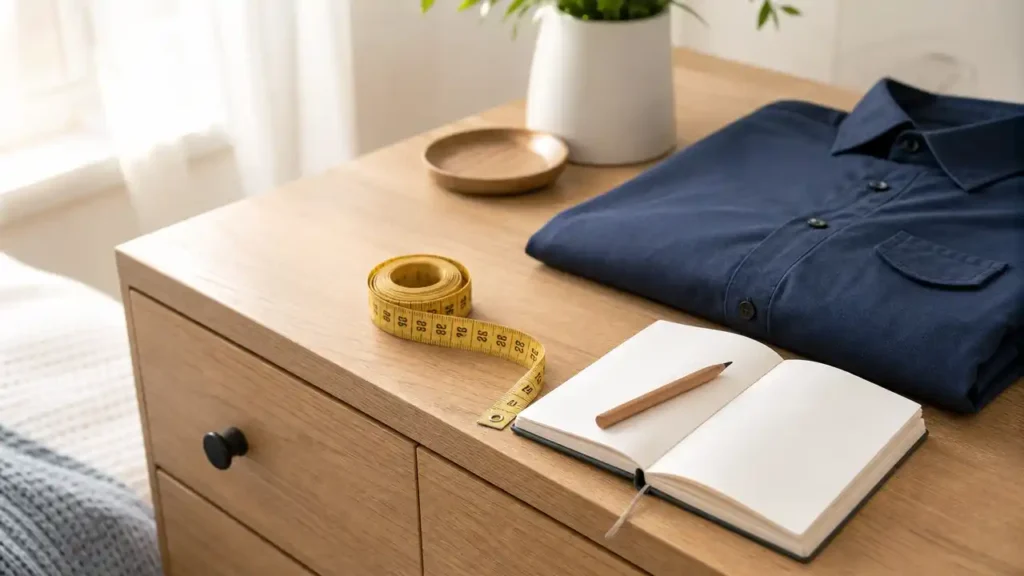
Size labels lie. A 2XL from one brand fits like a 3XL from another, so your own numbers are the only thing you can trust.
For shoulder width, run the tape across your upper back, from the bony tip of one shoulder to the bony tip of the other. Ask a friend to hold it, because reaching behind yourself throws the number off.
For your chest, wrap the tape around the fullest part, right under your armpits, and keep it level. No soft tape? Use a piece of string, then lay it flat against a ruler. Save both numbers in your phone.
Find Where the Shoulder Seam Lands on Your Best Shirt
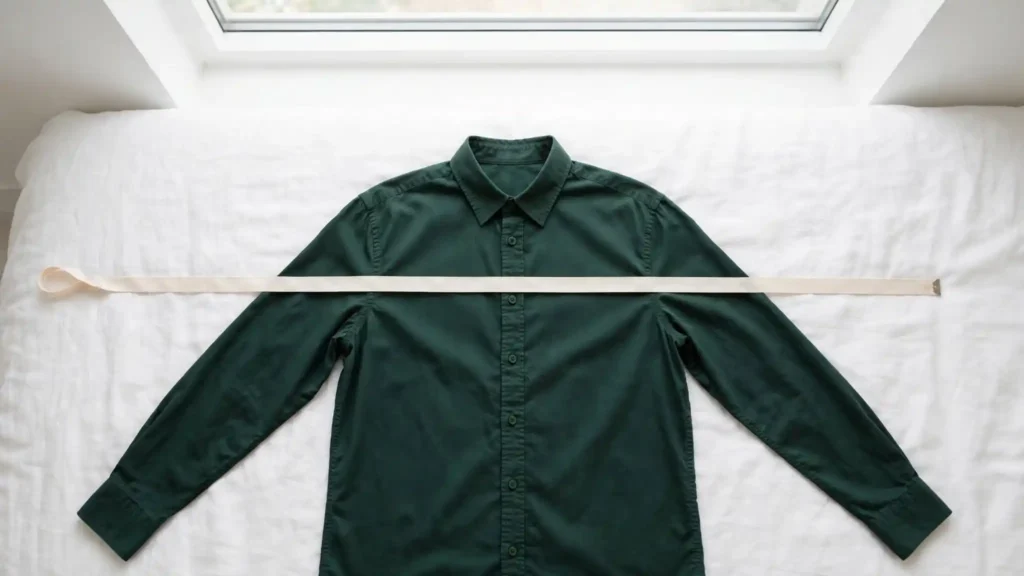
Your closet already holds the answer. Put on the shirt you feel best in and look at the seam where the sleeve meets the body.
It should sit right on that bony tip of your shoulder. Then take the shirt off, lay it flat, and measure from seam to seam. That number is your shopping guide from now on.
Size for Your Shoulders, Not Your Stomach

If the shoulder seam hangs 1 inch or more past your shoulder bone, the shirt is too big. It doesn’t matter how comfy the belly feels. Here’s why: extra fabric drops straight down from a wide point, so your whole torso turns into a rectangle.
Pick the size where the shoulders fit. If the middle feels tight in that size, look for big and tall lines or shirts labeled “relaxed fit through the body.”
Those cuts give you room at the stomach without stretching out the shoulders. Try sitting down in the shirt before you buy it. Buttons that pull open when you sit mean you need a different cut, not a bigger size.
Pick V-Necks and Open Collars to Narrow the Top
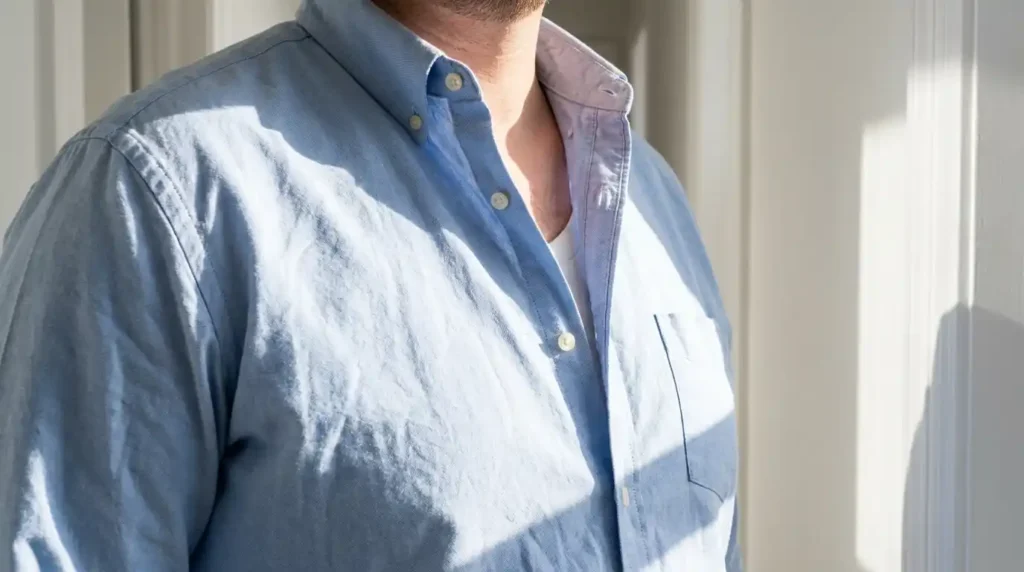
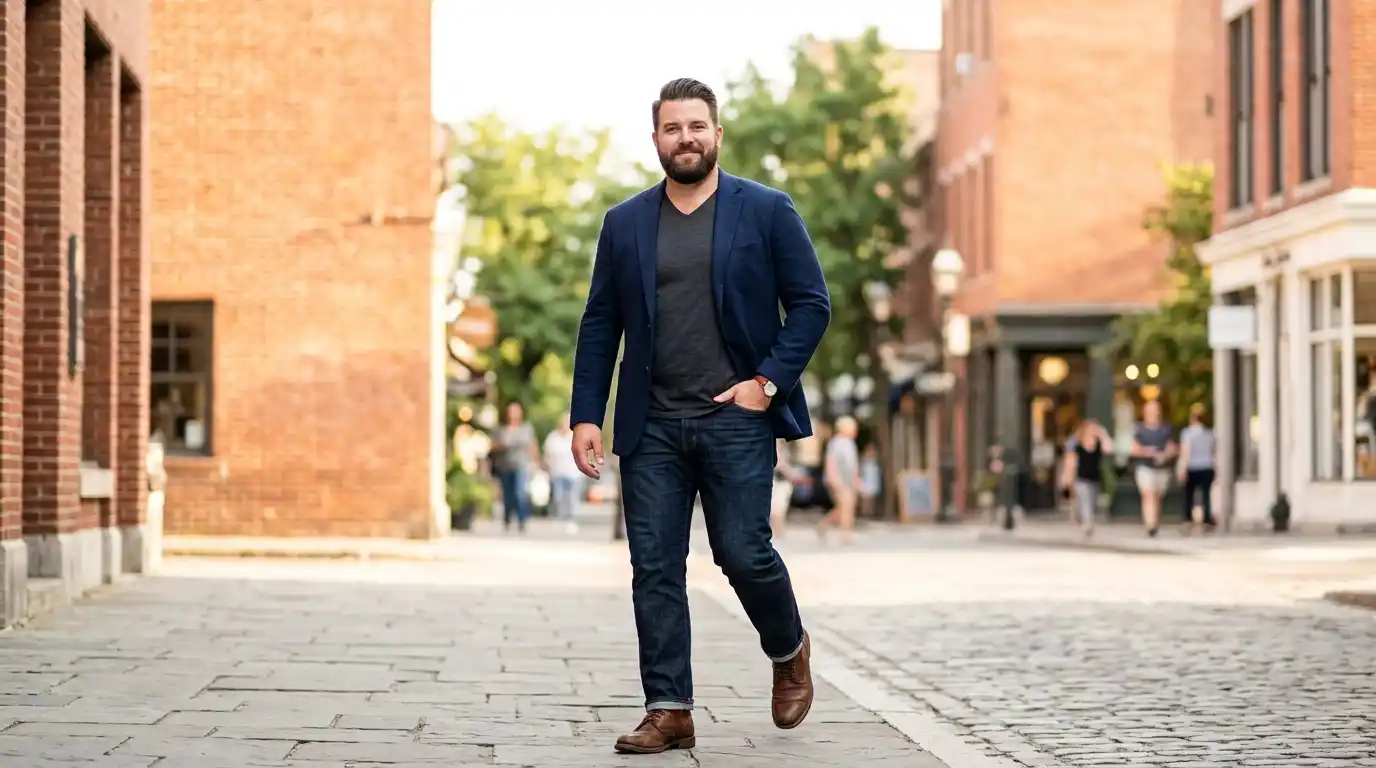
Two to three inches of open space below your collarbone changes how wide you look. A crew neck draws a flat line straight across your widest point.
A V-neck points the eye down instead, which makes your top half look longer and narrower.
On button-ups, leave the top 1 to 2 buttons open. Henleys work too if you undo 2 or 3 buttons. Keep the V shallow, though. A V that stops below mid-chest starts to look like a costume.
Add Vertical Lines Down the Front

Picture two straight lines running from your collar to your belt. Anything that creates those lines pulls the eye up and down instead of across. Pick one or two of these per outfit:
- An overshirt or cardigan worn unbuttoned
- A shirt with a visible front placket (the strip where the buttons sit)
- Thin vertical pinstripes spaced close together
- A zip jacket left open so the zipper edges hang straight
Hip-length or longer layers work best here. A layer that stops at your waist cuts the line short.
Choose Blazers With Soft, Unstructured Shoulders
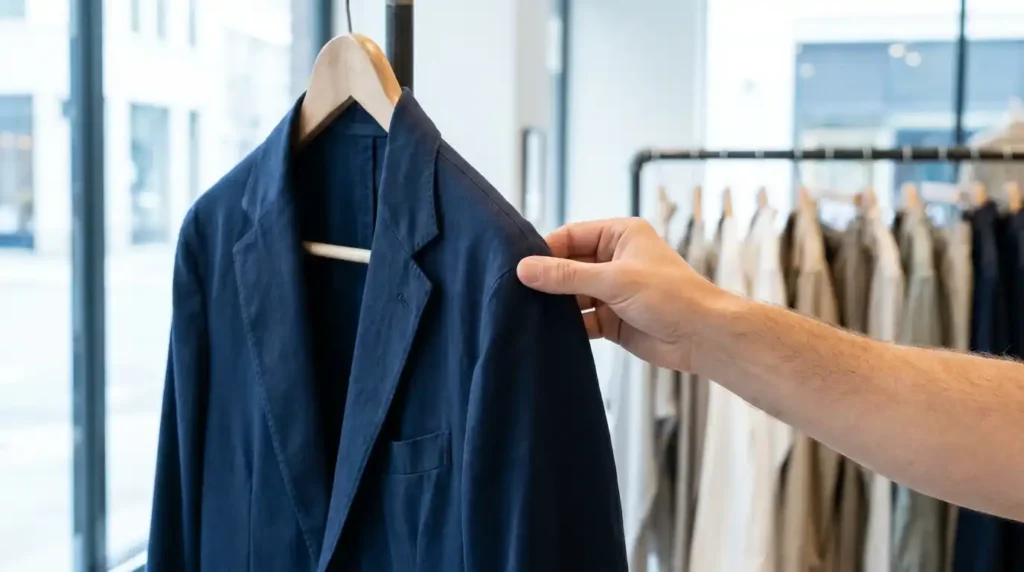
Most off-the-rack blazers hide foam pads in the shoulders. Each pad can add ½ inch to 1 inch of width per side, and that is the last thing broad shoulders need. Look for tags that say “unstructured,” “deconstructed,” or “soft shoulder.”
In the store, squeeze the top of the sleeve between your fingers. It should fold like a shirt, not push back like a cushion.
Stick with single-breasted styles with one or two buttons. Double-breasted jackets stack fabric across your chest and add even more width.
Medium lapels, about 3 to 3½ inches wide, look balanced. Skinny lapels make your shoulders look bigger next to them.
Drop the Shoulder Pads, Epaulettes, and Wide Stripes
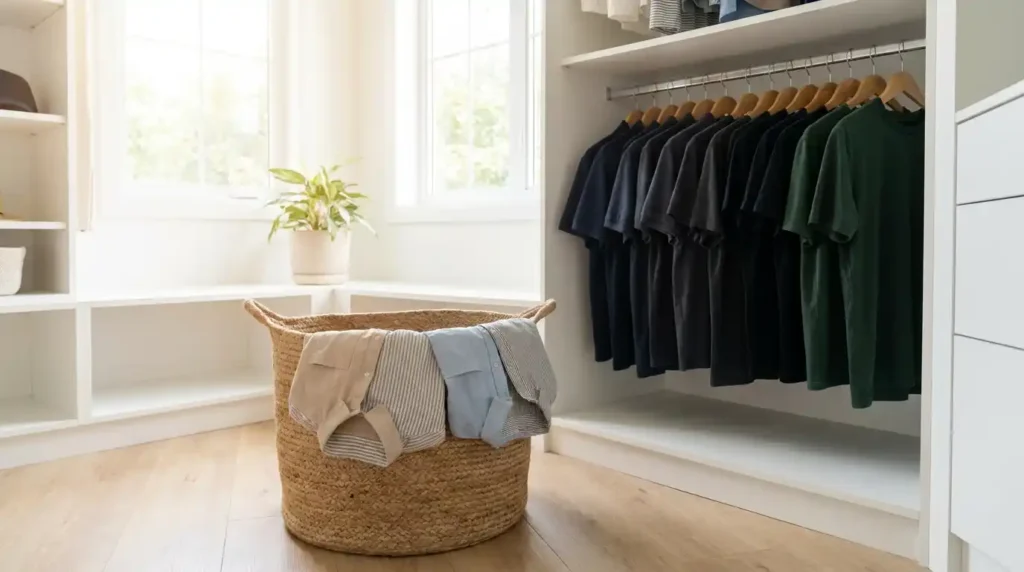
When a shirt has epaulettes (the little straps on top of the shoulders), they draw a line straight out to your widest point.
Puffy shoulder seams, flap pockets on both sides of the chest, and thick horizontal stripes do the same thing. Pull those pieces out of your rotation.
Shirts with raglan sleeves, which run in one slanted seam from the collar to the underarm, do the opposite. They soften the shoulder line, so keep those.
Wear Darker Solids on Top
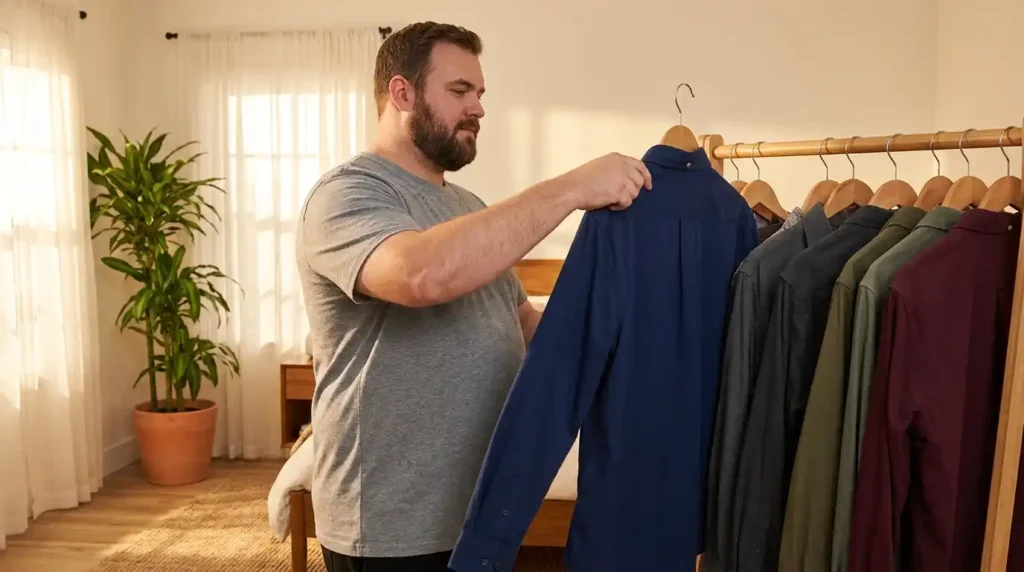
Navy, charcoal, olive, deep burgundy, and black all make an area look smaller. Bright and pale colors make it look bigger. That’s why a white tee on broad shoulders can feel like a billboard.
Pick darker solids for shirts and jackets. If you love patterns, keep them small, like a tiny check or a fine texture, rather than big plaids or bold prints.
Wearing the same dark shade top and bottom builds one long, unbroken column, which reads taller and slimmer.
You can still wear light colors. Put a white or gray tee under an open navy overshirt, and that light strip down the middle adds to the vertical line from Step 5.
Balance Your Top Half With Straight-Leg Pants
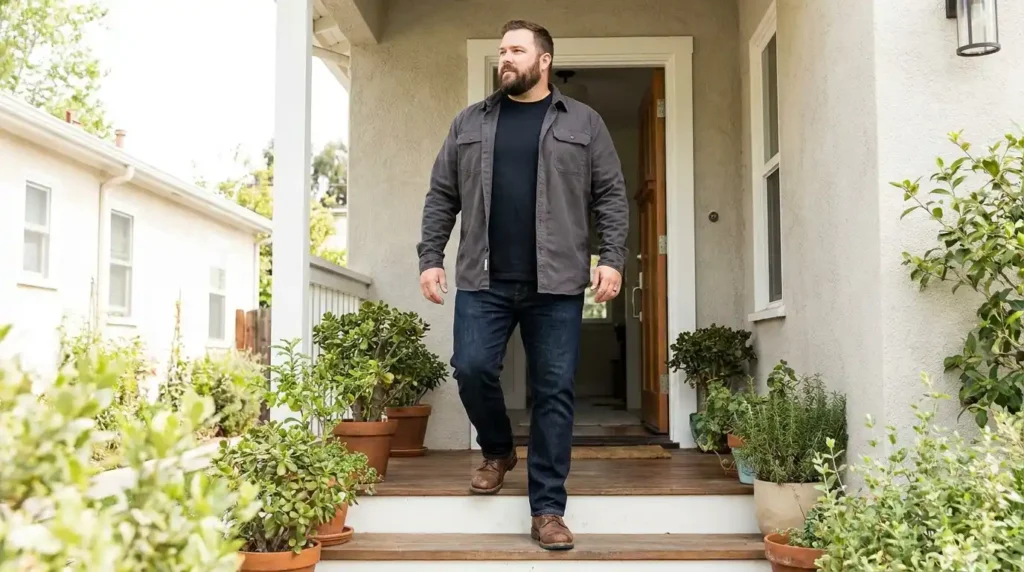
Proportion works like a seesaw. Skinny jeans shrink your lower half, so your shoulders look even wider by comparison, and you end up shaped like an upside-down triangle.
Choose straight-leg or relaxed-taper pants. Lay them flat and measure the hem opening.
Around 8½ to 10 inches across works for most plus size frames. Dark denim or chinos in charcoal, navy, or olive keep the look grounded.
Tailor Sleeves and Hems to the Right Length
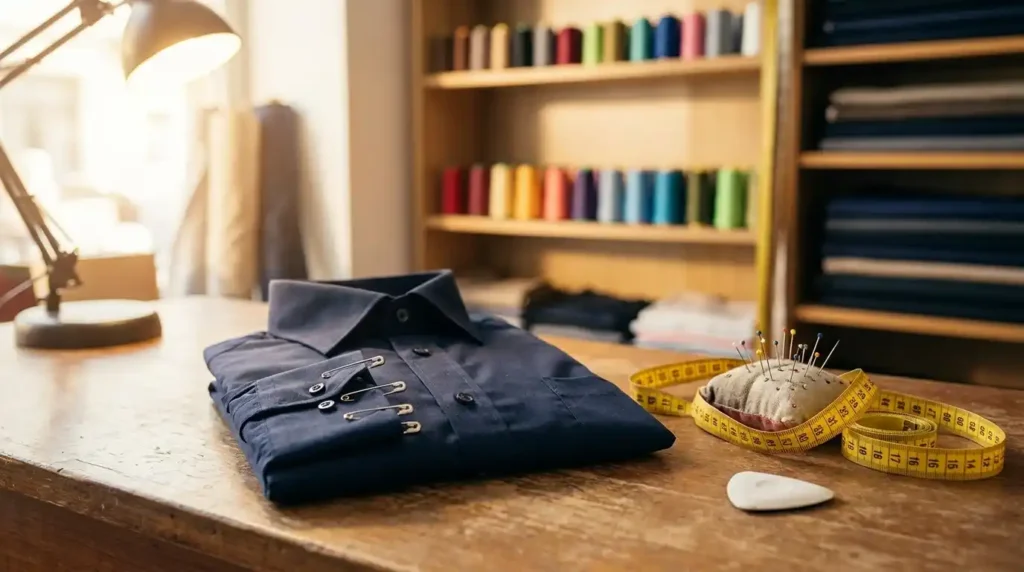
Store-bought clothes are cut for an average body. Broad shoulders and a bigger frame rarely match that average, so length is usually off somewhere.
Extra fabric bunching at the wrists or hips adds bulk you don’t want. Put on each piece, pin it with safety pins where it should end, and take it to a tailor with these targets:
- Shirt sleeves: cuff lands where your wrist meets your hand
- Blazer sleeves: show ¼ to ½ inch of shirt cuff
- Untucked shirts: hem ends around the middle of your zipper
- Pants: hem rests on top of your shoe with little or no bunching
Most of these alterations cost a lot less than buying new.
Check Your Outfit From Three Angles

Does your outfit look the same from across the room as it does up close? Often it doesn’t, so test it three ways.
Stand facing a full-length mirror and look for the V at your neck and the vertical lines down your front. Turn sideways next. The fabric should follow your shape instead of dropping straight from your shoulders like a tent.
Last, set your phone on a 10-second timer and take a full-body photo from about 6 to 8 feet away. If something looks boxy, change only one piece and shoot again.
- ✗ Shoulder seams hang down your arms
- ✗ Crew necks draw a flat line across your chest
- ✗ Padded jackets add width you don’t need
- ✗ Skinny jeans make your top look heavy
- ✗ Your torso looks like one wide block
- ✓ Seams sit right on your shoulder bone
- ✓ Open necklines point the eye downward
- ✓ Soft-shoulder layers follow your natural shape
- ✓ Straight-leg pants balance your frame
- ✓ Your build looks longer, stronger, and put together
Conclusion
You now know your real measurements, the fit to shop for, and the swaps that turn a wide block into a balanced frame.
That’s the core of how to dress broad shoulders as a plus size man: fit the seam, open the neck, and keep the lines running up and down.
Your next step is to take your three test pieces to a tailor this week and get the lengths right.
Save this pin to your style board so the cheat sheet is ready the next time you go shopping.