
The shirt looked right at 7:10 a.m. Shoulders sat flat, buttons lay closed, color looked sharp in the bedroom mirror. Then he dropped into the car seat and the third button pulled sideways into a small open gap right above the belt.
He drove twenty-five minutes to a brand-new job steering with one hand and holding his shirt shut with the other.
That gap is the real problem behind what to wear to your first day of work as a plus size man. We try clothes on standing still, then wear them sitting down for eight hours straight.
By the end of this guide you will have one complete outfit hanging on a door, already tested in a chair, matched to the actual dress code of the place you are walking into.
Not a shopping spree. You will buy two pieces and build the rest from the closet you already own.
The method works because it fixes fit in the four places bigger bodies get failed by clothing: the shoulder seam, the third button, the waistband and the tuck.
Fix those four and an ordinary shirt starts behaving like a tailored one.
Read the Dress Code From Your Offer Letter, the Team Page and One Email

Guessing here costs you the whole day. Overdressed in a warehouse office feels as wrong as showing up tieless to a law firm, and you cannot fix either at 9 a.m.
Three places hold the answer. Your offer letter or onboarding PDF often names it outright — business casual, business professional, smart casual.
The company’s team page or LinkedIn photos show what people actually wear, which sometimes differs from the handbook. And your recruiter or new manager will answer a direct question in one line.
Send this: “Looking forward to Monday. What do people usually wear in the office?” Nobody has ever thought worse of a new hire for asking.
Sort the answer into one of three lanes and keep it in mind for every step below.
- Corporate — blazer, dress shirt, tailored trousers, leather shoes.
- Business casual — collared shirt, chinos or dark denim, no tie.
- Smart casual — polo or overshirt, dark chinos, clean leather sneakers.
When answers conflict, dress one notch up from the photos. You can take a blazer off by lunch. You cannot add one.
Pull Every Collared Shirt You Own and Sort Them Into Three Piles
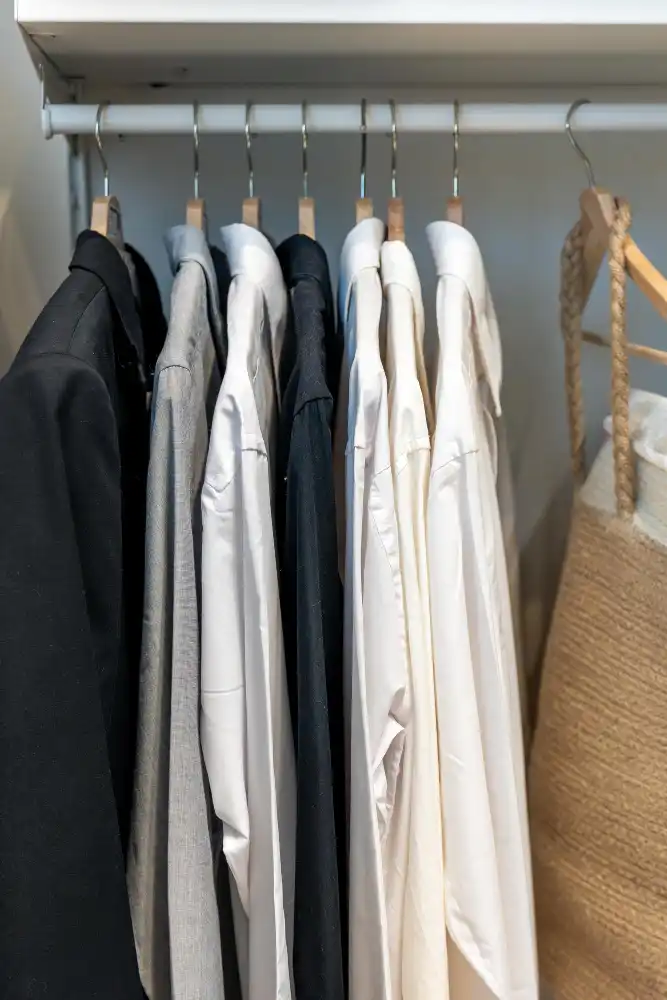
Your closet is lying to you right now, because shirts that fail are hanging next to shirts that work and they all look identical on a hanger. Put each one on. Button it fully. Stand in front of the mirror, then sit down in the chair and look again.
Pile one: wears today with no changes. Pile two: fixable tonight — needs a press, a sleeve roll, a different button spacing. Pile three: out, because it pulls at the chest, bunches at the waist or the collar closes tight on your throat.
Most men end up with one shirt in pile one and three in pile three. That is a normal result, not a bad one. It tells you exactly what the next step has to buy.
Take a photo of yourself seated in each pile-one and pile-two shirt. The camera catches gaps your eye slides past.
Buy Two Pieces Only, Sized to Your Chest and Your True Waist
Shopping blind is how men end up with a closet full of size 3XL tents. Measure first, at home, before you open a single website.
Wrap the tape around the fullest part of your chest with your arms down, and breathe normally — that number sizes the shirt. Then wrap it where the waistband will actually sit on your body, which for many bigger men is below the belly, not at the navel.
That second number is usually 2 to 4 inches larger than the size printed in your old trousers, and that is why those trousers slide down all day.
Buy to the larger measurement and have the rest taken in. A shirt that fits your chest with a loose waist can be tapered for around $15 to $25. A shirt too tight across the chest cannot be rescued by anything.
Look for woven cotton with 2% to 5% elastane on the label. That small amount of stretch is what keeps the button line flat when you reach across a desk. Stiff 100% cotton looks sharp on the hanger and fights you every time you move.
If the budget allows one upgrade, spend it on the trousers.
Check the Shoulder Seam First, Then the Gap at the Third Button

Stand square to the mirror and find where the seam lands on each shoulder. It should sit on the bony corner where your arm starts, not halfway down your bicep. A seam that has slid down your arm means the shirt is oversized everywhere else too, and no amount of tucking will hide that.
The shoulder is the one measurement a tailor cannot fix for a reasonable price. Everything below it can be taken in.
Now sit down and look at the button line between your chest and your belt. Light pulling that disappears when you straighten up is fine. A visible open gap is not — it will be there all day, in every meeting.
Set the Waistband Above or Below Your Belly, Never on Top of It
If your trousers creep down by lunchtime, the waistband is sitting on the curve of your stomach, and gravity is doing the rest. Fabric cannot grip a slope. It has to rest in a place where the body is narrower above or below it.
Pick one position and commit, because the two need different trousers.
- Below the belly — the waistband sits low on the hips, under the curve. Buy by your hip measurement. Keep the shirt tucked and the belt snug.
- Above the belly — the waistband sits at the natural waist, near the navel, with the stomach falling below it. Buy a higher-rise trouser. This is the more polished look and the one most corporate offices expect.
Whichever you choose, do up the waistband and slide two fingers inside it. Two fingers fit comfortably, one finger means tight by 3 p.m., four fingers means it will slide.
Then walk the length of your hallway and back. The waistband should stay where you set it the whole way.
Hem the Trousers So They Break Once Over the Laces

One soft fold across the top of the shoe is the target. The hem should touch the laces and stop, with no pooling of fabric around the ankle and no bare sock showing when you stand.
Too long reads sloppy from across a room, and it is the single most common reason an expensive pair of trousers looks cheap. Too short reads unfinished.
Put the shoes on before you measure. Heel height changes the hem by up to half an inch, so measuring in socks gives you the wrong number every time.
A tailor will do this for $12 to $20 in a day or two. If Monday is tomorrow, iron-on hem tape from any drugstore holds through a full workday and washes out later.
Choose an Undershirt That Handles Day-One Sweat Without Adding Bulk

Nerves raise your body temperature before you reach the lobby. On a bigger frame that shows up in two places: a ring under each arm and a damp patch in the middle of the back where the shirt touches the chair.
A cotton undershirt soaks it up and holds it against you. A thin synthetic blend moves it away and dries. Look for a micro-modal or cotton-poly mix in a v-neck, so no white collar peeks above an open button.
Three things make an undershirt work instead of making you look thicker:
- A grey or tan color, not white, which disappears under light shirts
- A hem long enough to tuck and stay tucked
- Flat side seams, no ribbing, nothing that prints through
Pull it on and run your hand down your side. If you can feel a ridge through the dress shirt, the undershirt is too heavy for the job.
Lock the Tuck So Your Shirt Stops Climbing When You Sit Down

Shirts ride up on bigger bodies because there is more surface pushing the fabric upward and nothing holding it down. The standard tuck gives out within an hour.
Use the military tuck instead. Button and tuck the shirt loosely first. Then pinch the loose side fabric at each hip, fold it flat toward your back like closing a paper bag, hold it there and pull the waistband up over it. The folds sit under the belt and stop the shirt billowing out at the sides.
Fasten the belt while you are still holding the folds. Let go only after the buckle is closed.
Give it a test: raise both arms straight overhead, then drop them. A locked tuck stays. A loose one pops out at the back, which is exactly what happens the first time you reach up to a whiteboard.
Match One Leather Belt to One Pair of Leather Shoes and Leave the Rest Off

Brown belt, brown shoes. Black belt, black shoes. That is the whole rule, and breaking it is the detail people notice without knowing why.
Belt width matters more than most men expect. A 1.25 to 1.5 inch strap reads as dressed. Anything wider pulls the eye straight to your middle and reads casual no matter what else you are wearing.
Buy the belt to your actual waist measurement, not your trouser size, and aim to fasten on the middle hole. A belt on its last hole with a long tail hanging down tells the room the belt is too big.
For shoes, a plain leather derby or clean dark sneaker covers all three dress codes. Polish them tonight.
Then stop. One watch is plenty. No tie pin, no bracelet, no sunglasses on the collar on day one.
Wear the Whole Outfit for 20 Minutes and Sit, Reach and Climb Stairs in It

Everything up to now was tested one piece at a time. Clothes behave differently once they are layered, belted and tucked together.
Get fully dressed the night before — undershirt, shirt, trousers, belt, shoes, watch. Set a timer for 20 minutes and live in it.
Run these four moves, in this order:
- Sit in a hard chair for five full minutes
- Stand and check the button line and the tuck in the mirror
- Reach both arms forward, then overhead
- Walk up and down a flight of stairs
Anything that fails here is fixable tonight. The same failure at 9 a.m. is not.
Take two photos while you are dressed, one standing and one seated. Look at them tomorrow morning instead of second-guessing yourself in the mirror, because the version you already approved is the version that works.
Hang the whole outfit on a door before you take it off. That removes every decision from Monday morning.
The One Thing That Matters Most
You now have a full outfit hanging on a door, already tested in a chair, matched to the dress code of the place you are actually walking into.
Of everything in this guide, the 20-minute rehearsal is the step to protect. Fit problems are quiet until you move, and moving is the whole of a first day.
Next week, run the same chair test on two more shirts and send them to the tailor together. That is how a working wardrobe gets built, one proven piece at a time.
Questions Big Guys Ask Before Day One
Should I Wear a Blazer If I Am Not Sure It Fits Right?
Only if you can button it while standing without pulling at the chest. If it will not close, carry it over your arm or leave it home. A blazer worn open with the shoulders fitting correctly still works.
Is an Untucked Shirt Ever Acceptable on Day One?
In a smart casual office, yes, but only if the hem stops at your mid-zipper. Anything longer looks borrowed. Most dress shirts are cut too long to wear out.
Do I Have to Wear All Black to Look Slimmer?
No. Fit does far more than color. Navy, charcoal, olive and deep green all work, and a single mid-tone shirt with dark trousers reads better than head-to-toe black on a first day.
What If Nothing I Own Fits and Payday Is After My Start Date?
Take your best-fitting shirt to a tailor for a side taper at around $20 and press everything else. One well-fitted shirt worn Monday beats a new one that pulls.
Can I Wear Sneakers?
In smart casual offices, clean leather sneakers in black or white are fine. Avoid running shoes, mesh panels and bright soles. In corporate or business casual, stay with leather shoes on day one and watch what others wear.