You found out about the interview three days ago. Since then, you’ve tried on the suit from your cousin’s wedding, watched the jacket refuse to button, and started wondering if a nice sweater counts.
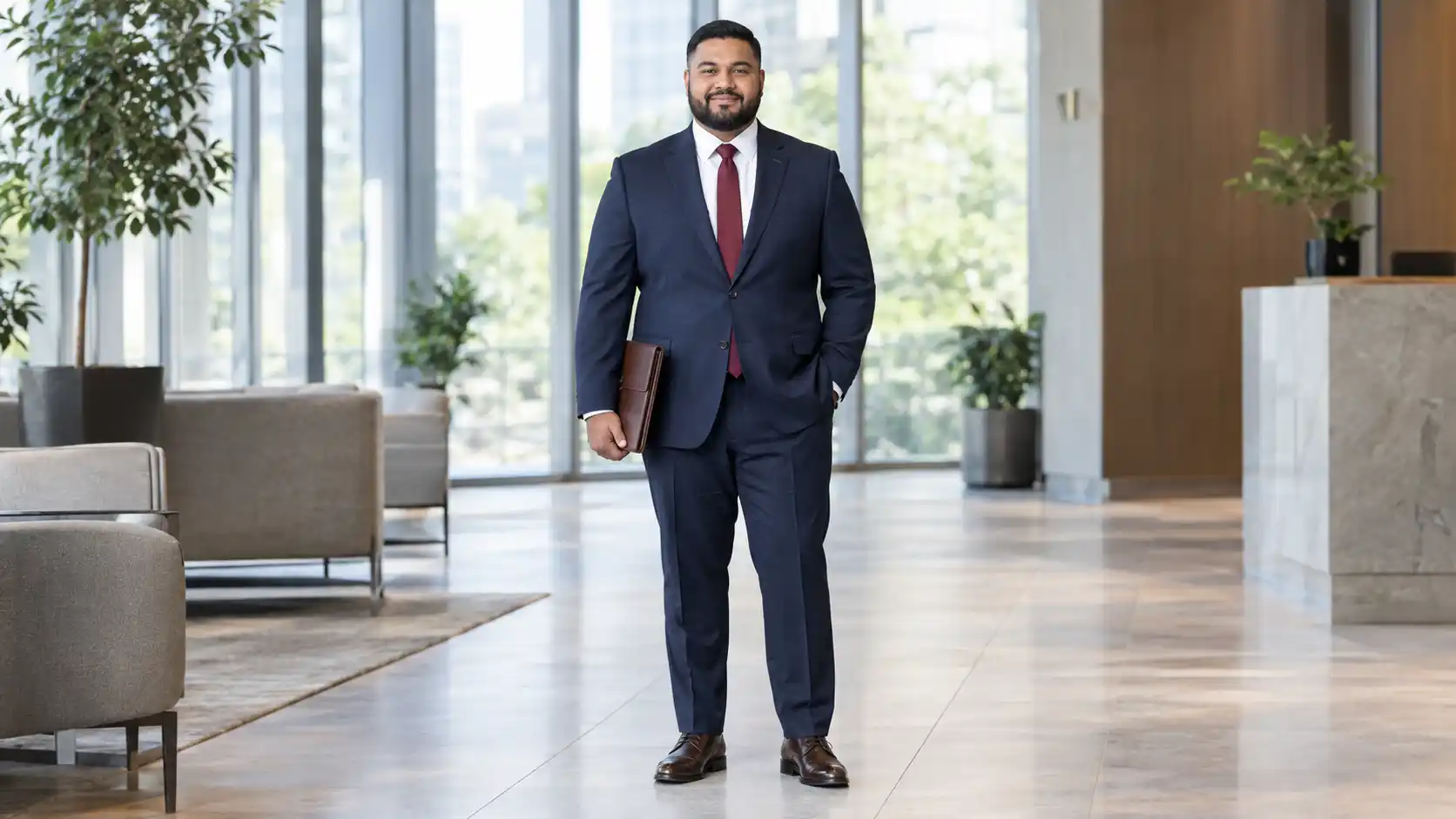
For a bigger guy, interview clothes can feel like a trap. Off-the-rack suits are cut for a different body, and most style advice skips you completely. This guide shows you how to dress for a job interview as a plus size man so you look put-together, not squeezed in or swallowed up.
By the end, you’ll have a full outfit that fits your shoulders, sits right at your waist, and stays comfortable through a long conversation. The method is built around fit, not hiding.
A suit that fits well makes a big frame look solid and confident. A suit that’s too loose makes you look bigger and less sure of yourself.
Here’s the honest part. Shopping and trying things on takes about 3 to 4 hours. Tailoring adds a week or two, so start early if you can. None of it is hard.
It’s a series of small choices made in the right order. Grab a soft measuring tape, and let’s start with what the company expects.
Check the Company’s Dress Code Before You Buy Anything

Buying the wrong level of formal is the most expensive mistake on this list. A tech startup might expect chinos and a blazer. A bank or law firm expects a full suit and tie. Spend 10 minutes finding out which one you’re walking into:
- Look at the “About” or “Team” page on their website.
- Scroll through employee photos on LinkedIn.
- Check their Instagram for office shots.
- Ask the recruiter what people usually wear to interviews.
That last one feels awkward, but recruiters get this question all the time. If you still can’t tell, dress one level above what employees wear day to day. A suit in a casual office looks keen. Chinos in a formal office look unprepared.
Measure Your Chest, Waist, Neck, and Sleeve With a Soft Tape
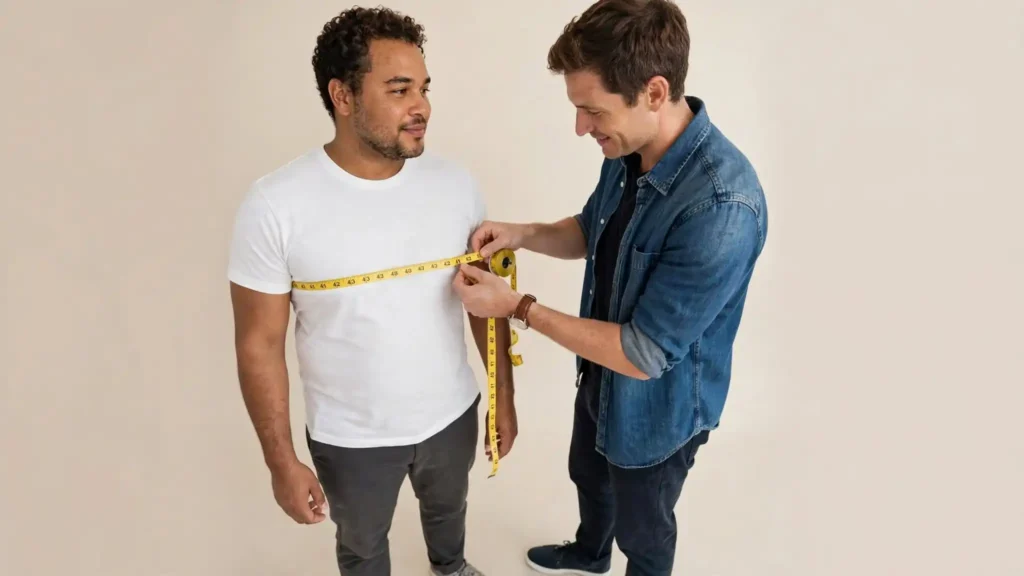
A 2XL from one brand can fit like an XL from another, so letter sizes won’t help much. Real numbers will. Ask a friend to help, because measuring your own back and sleeves is hard to get right alone.
Stand relaxed and breathe normally. If you suck in your stomach, you’ll get a number your clothes won’t agree with later.
For your chest, wrap the tape under your armpits around the fullest part, keeping it level across your back. For your waist, measure around your belly button, where your trousers will sit.
For your neck, measure around the base where a collar rests, then add ½ inch for breathing room. For your sleeve, start at the center back of your neck, go over your shoulder, and stop at your wrist bone with your arm slightly bent.
No soft tape? Use a phone charger cord or a piece of string, then lay it against a metal tape measure. Save all four numbers in your phone.
Take each measurement twice. If the two numbers are more than ½ inch apart, measure a third time and use the middle number.
Pick a Solid Navy or Charcoal Suit
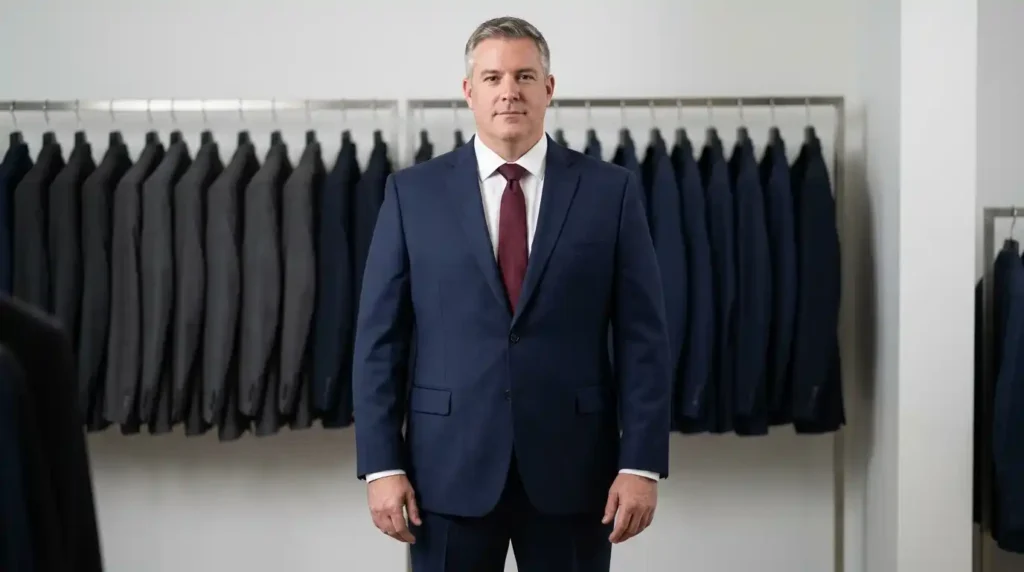
If you only buy one suit this year, make it navy or charcoal. Dark, solid colors soak up light instead of bouncing it back, which softens the outline of a bigger body.
They also look serious without looking stiff. Skip black. It reads more like funeral or evening wear, and it shows every speck of lint.
Fabric matters as much as color. Shiny polyester catches the light on every curve.
Look for wool or a wool blend around 9 to 11 oz, which breathes better and keeps you cooler when nerves kick in. Bold stripes and big checks add width, so keep patterns faint or skip them.
Interviewing at a business casual office? Swap the suit for a navy blazer and charcoal trousers. The same color and fabric rules apply.
Choose a Single-Breasted Jacket With Two Buttons
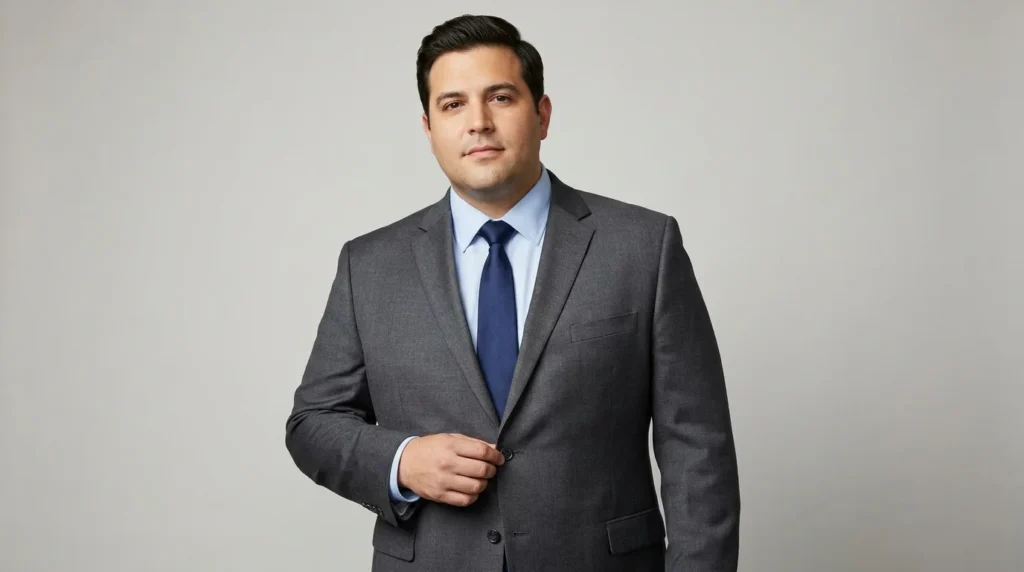
Your jacket’s buttons decide where people’s eyes go. Two buttons create a deep V from your collar to your waist, and that long vertical line makes your upper body look taller and narrower.
Three-button jackets close higher and cut that line short. Double-breasted jackets layer extra fabric across your stomach, right where you don’t want it.
Look for notch lapels about 3 to 3½ inches wide. Skinny lapels look tiny next to broad shoulders, and wide peak lapels add bulk.
When you stand, fasten only the top button, never the bottom one. Undo it before you sit down so the jacket doesn’t pull across your middle.
Skip anything labeled “slim fit,” even when the size number matches yours. Slim cuts narrow the chest and waist together, so the button pulls the fabric into an X across your stomach. Look for “classic,” “regular,” or “portly” fits instead.
Fit the Jacket to Your Shoulders First
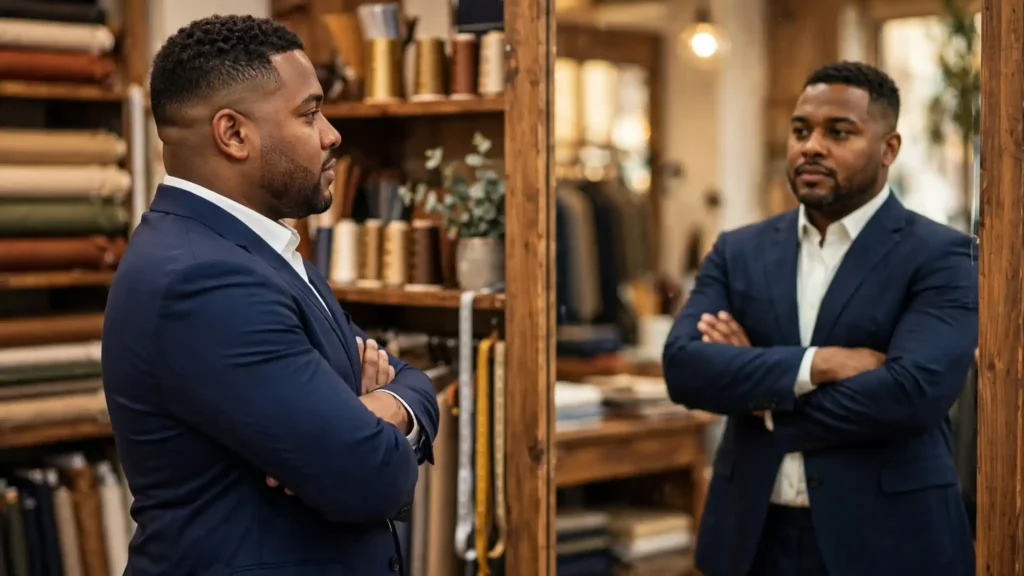
Tailors can shorten sleeves, take in a waist, and let out the back. Shoulders are a different story. Fixing them costs nearly as much as a new jacket, and sometimes it can’t be done at all. That makes shoulders the part that decides your size.
Put the jacket on, stand in front of a mirror, and check four things:
- The shoulder seam ends where your shoulder bone ends.
- No dent or ripple appears below the shoulder pad.
- The top button closes without the fabric pulling into an X.
- You can cross your arms without the back feeling tight.
Torn between two sizes? Pick the smaller one only if it passes all four checks. Otherwise, go up a size and let the tailor take in the waist. Taking in extra fabric is a small, cheap job. Adding fabric that isn’t there is close to impossible.
Shop “suit separates,” where the jacket and trousers are sold in different sizes. Most regular suits assume your waist is about 6 inches smaller than your chest. Separates let you buy each piece to fit your real body.
Wear Your Trousers at Your Natural Waist, Not Under Your Belly
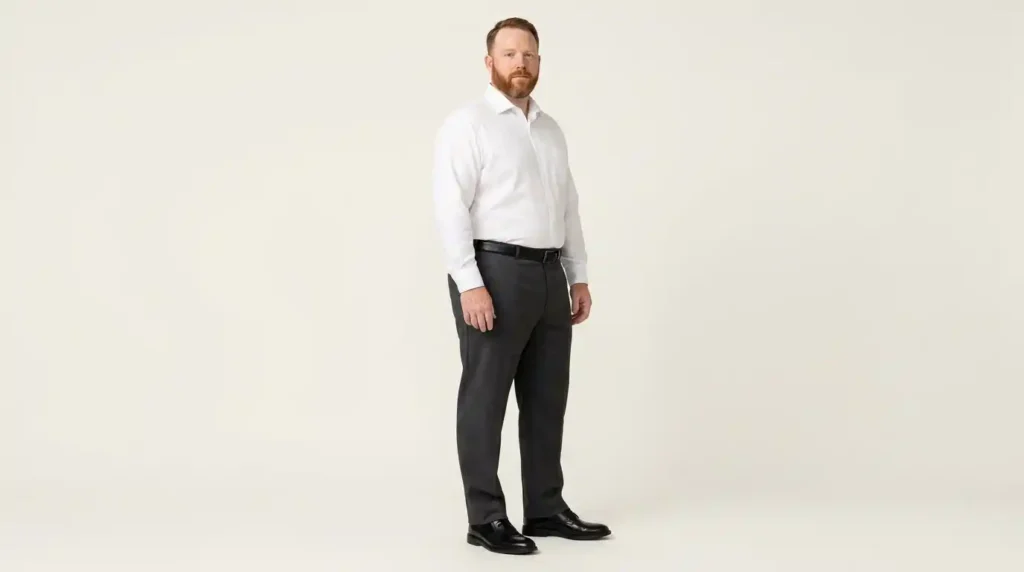
Ever spent a whole meeting hitching up your pants? That happens when trousers sit below the belly. They slide down every time you move, the crotch hangs low, and extra fabric bunches up at your ankles.
Look for mid-rise or high-rise trousers with a front rise of about 11 to 12 inches or more. Wear the waistband at or a little above your belly button.
Sitting there, it stays in place, and your jacket and trousers form one clean, unbroken line.
Single pleats are fine and give more room through the thighs and seat. Side adjusters or a stretch waistband add about 2 inches of comfort for long days.
One common slip: buying by your jeans size. Jeans sit lower, so use the waist number you measured in Step 2.
Buy Dress Shirts by Neck and Sleeve Size, Not S, M, or L
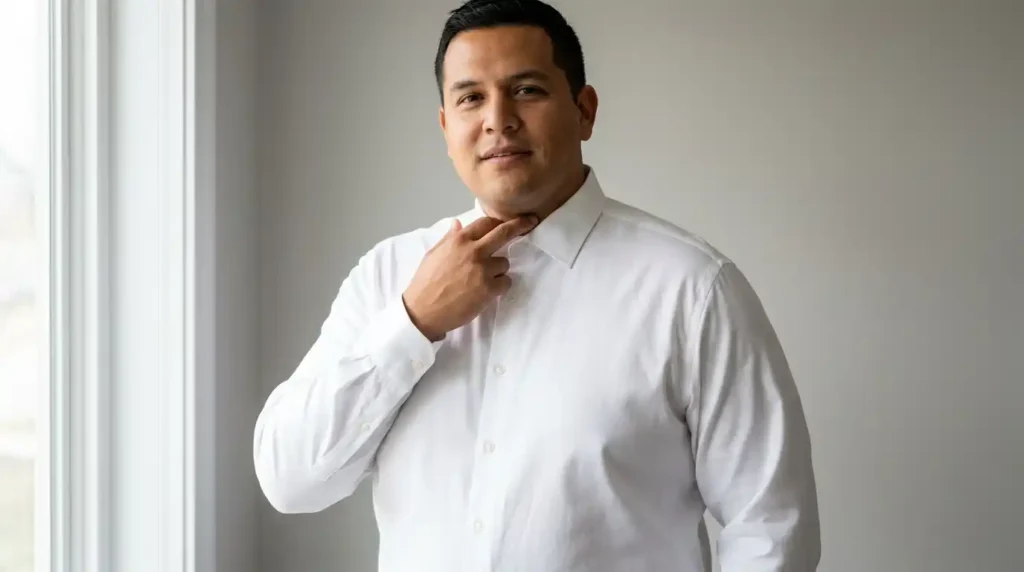
Two numbers on the tag tell you almost everything, like 18½ 35/36. The first is your neck size and the second is your sleeve length, and you already have both from Step 2.
Look for “classic fit” or “big and tall” cuts. Be aware that “big” adds width while “tall” adds length, so check which one you need.
Try it on and run these checks before you buy:
- Button the collar and slide two fingers inside. If they won’t fit, go up ½ inch.
- The cuff ends at your wrist bone.
- The buttons lie flat across your chest and stomach, with no gaps.
- The shirt stays tucked when you raise both arms.
A tight collar matters more than it seems. Sitting for 45 minutes in one will turn your face red. Stick with white or light blue, and skip gray, because it shows sweat marks fast.
Pick a Tie Long Enough to Reach Your Belt Buckle
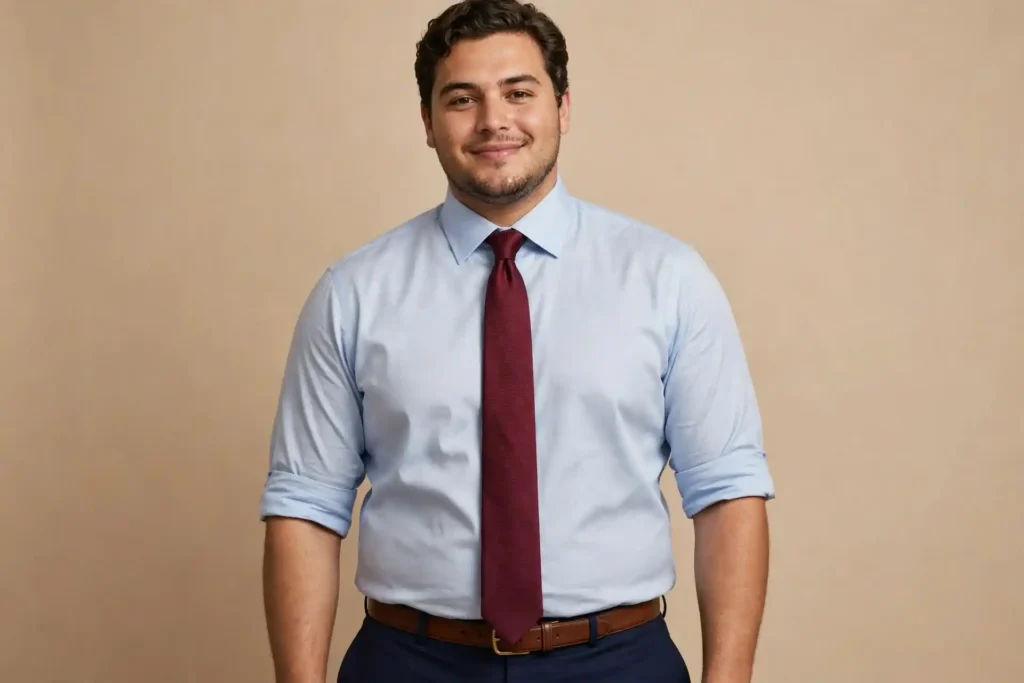
A tie that stops halfway down your stomach makes your upper body look wider. Standard ties are about 57 to 58 inches long, and on a bigger chest they end up short.
Buy an extra-long tie, labeled “XL” or “big and tall,” at 61 to 63 inches. The tip should land on the middle of your belt buckle.
Match the tie width to your lapels, which is about 3 inches for most suits. Tie a four-in-hand knot. It’s smaller and uses less length than a Windsor.
Pick a solid color or a small, quiet pattern in burgundy, navy, or dark green. Busy prints pull attention away from your face.
Match Your Belt and Shoes, or Switch to Suspenders
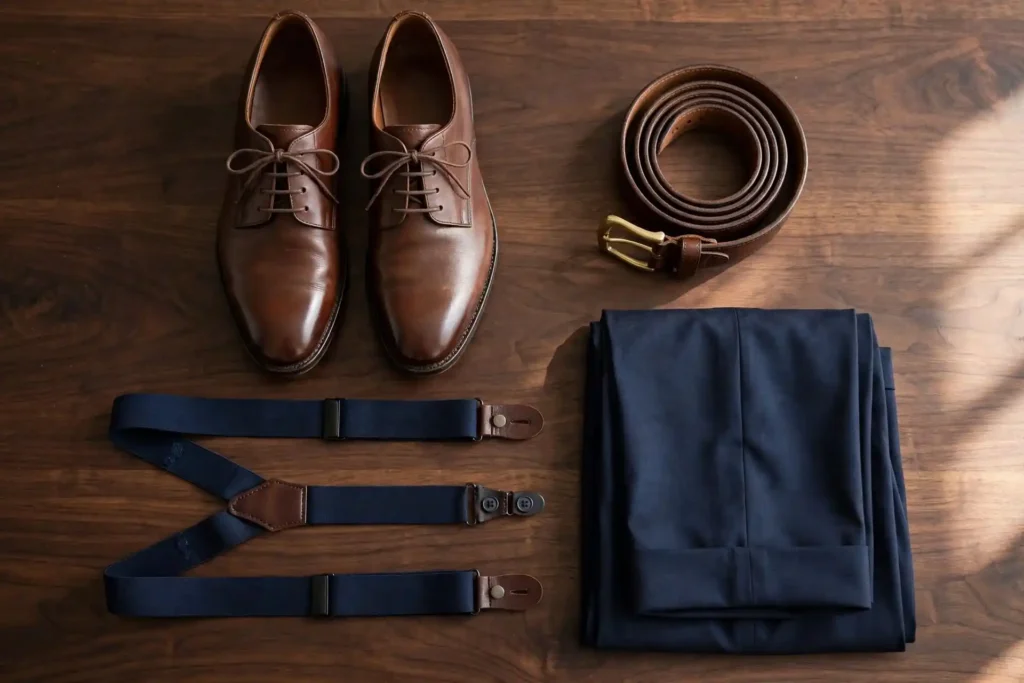
Brown belt, brown shoes. Black belt, black shoes. With a navy suit, either color works. With charcoal, black looks cleaner. Buy a belt 2 inches longer than your waist size so the buckle sits on the middle hole.
Many bigger guys find that belts roll under the belly and let trousers slip. Button-on suspenders fix that.
A tailor can sew buttons inside your waistband for about $10 to $20, and nobody sees them under the jacket. Avoid clip-on suspenders, which can pop loose and look cheap.
For shoes, derbies have open lacing that gives wide feet more room than oxfords. If your feet are wide, look for E or EE widths. Polish them the week before.
Never wear a belt and suspenders together. Pick one. If you go with suspenders, choose trousers without belt loops, or have the tailor remove them.
Take the Outfit to a Tailor at Least One Week Early
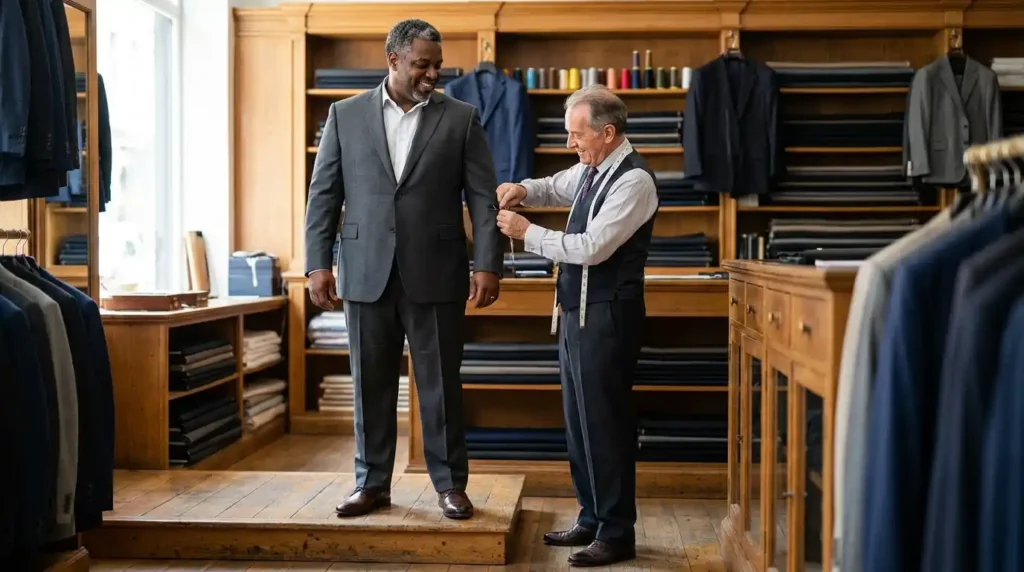
Seven days is the bare minimum. Many tailors need 5 to 7 days, and some need longer during wedding season. Bring the shirt and shoes you’ll wear to the interview, since both change where sleeves and hems should fall.
Ask for these fixes:
- Shorten the jacket sleeves so ¼ to ½ inch of shirt cuff shows.
- Hem the trousers so they touch the top of your shoes with a slight fold.
- Take in the jacket waist if it hangs loose after sizing up.
- Let out the trouser seat if it feels tight. Most have 1 to 1½ inches of spare fabric.
Expect to pay about $15 to $25 for a hem, $20 to $40 for sleeves, and $25 to $40 for a waist. Pick everything up a few days before the interview, not the morning of.
Test Your Outfit the Day Before
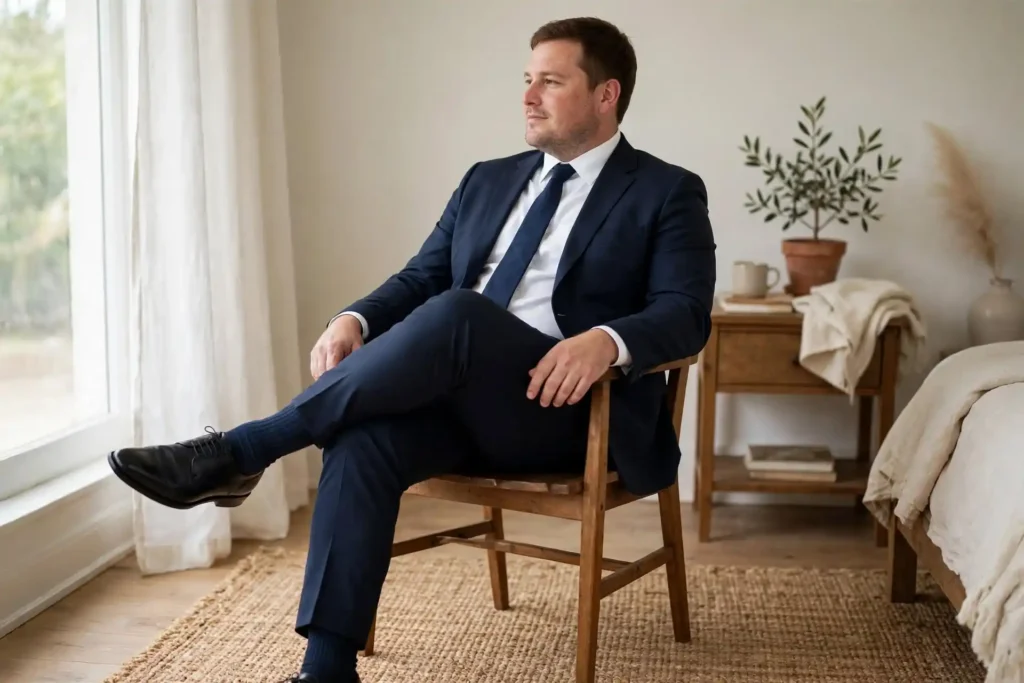
Mirrors can fool you when you’re standing still. Interviews happen sitting down, so put on the whole outfit and sit in a chair for 10 minutes.
Watch for a waistband that digs in, shirt buttons that gap across your stomach, and trousers that pull tight at the thighs.
Cross your legs. If skin shows above your socks, switch to over-the-calf socks. Reach forward like you’re shaking hands, then walk for 5 minutes, including a flight of stairs if you can.
Write down anything that pinches. A loose button or a tight collar can still be fixed tonight. Tomorrow, it can’t.
Steam the Outfit and Lay It Out the Night Before
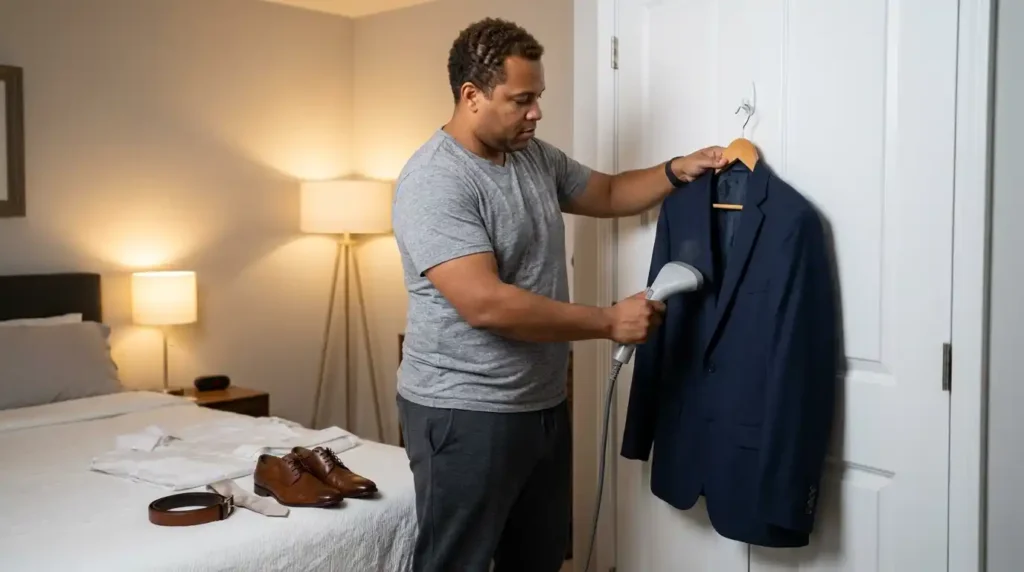
Wrinkles show up most on bigger frames, where fabric stretches and creases across the stomach and the backs of the knees.
Hang the suit and steam it from top to bottom, holding the steamer about 6 inches away. No steamer? Hang it in the bathroom during a hot 15-minute shower. Iron the shirt on the cotton setting.
Then lay out everything in one spot:
- Suit and shirt on hangers
- Tie, belt or suspenders
- Socks and polished shoes
- A moisture-wicking V-neck undershirt that won’t peek out at the collar
Rub anti-chafe balm on your inner thighs in the morning. Drop a lint roller in your bag for one last pass before you walk in.
Never press a wool suit directly with a hot iron. It leaves a shiny mark that won’t come out. Place a thin cotton towel between the iron and the fabric, or stick with the steamer.
📌 Plus Size Interview Outfit Cheat Sheet
- Navy or charcoal wool suit
- White or light blue dress shirt
- Extra-long tie (61–63″)
- Belt or button-on suspenders
- Dark leather shoes + over-the-calf socks
- Moisture-wicking V-neck undershirt
- Soft tape, steamer, lint roller
- Tailor budget: $40–$100
- Check the dress code (10 min)
- Measure chest, waist, neck (+½”), sleeve
- Buy navy or charcoal, wool, 9–11 oz
- Single-breasted, 2 buttons, notch lapels
- Fit shoulders first; tailor the rest
- Trousers at belly button, 11–12″+ rise
- Shirts by neck/sleeve; 2-finger collar
- Tie tip lands on belt buckle
- Match belt + shoes, or suspenders
- Tailor at least 7 days out
- Sit 10 min, walk 5 min, check fit
- Steam + lay out the night before
You’re Ready to Walk In
You now know how to dress for a job interview as a plus size man, and you have a suit that fits your body, not the hanger.
The shoulders sit right, the trousers stay put, and the tie lands where it should. That’s one less thing to think about when the questions start.
As a next step, use the same measurements to build a second outfit for the follow-up interview. A gray suit or a navy blazer with charcoal trousers works well.
Frequently Asked Questions
Can I skip the jacket if it’s hot outside?
Carry it and put it on before you walk in. A jacket gives a bigger frame structure and hides sweat. Taking it off in the interview reads as too casual in most offices.
What if no suits fit me off the rack?
Try big and tall stores or suit separates first. If neither works, made-to-measure suits from online shops are built from your own measurements and often cost less than people expect.
Should I wear a vest to look more put-together?
Usually not. A vest adds another layer of heat and can ride up over your stomach when you sit. A well-fitted two-piece suit looks cleaner.
I sweat a lot when I’m nervous. What helps?
Apply antiperspirant the night before so it has time to work. Wear a moisture-wicking undershirt, arrive 10 minutes early to cool down, and keep a handkerchief in your pocket.
Is a polo or sweater okay for a casual office?
A button-up shirt under a navy blazer is safer. Polos and thin sweaters tend to cling to the stomach, while a blazer keeps your shape clean.
Can I tailor a suit I already own instead of buying new?
Yes, if the shoulders fit and the jacket buttons without pulling. If either one fails, the tailoring bill will likely cost more than the suit is worth.